Victim v. State of Baden-Württemberg (LfDI)
Supervisory proceedings against the State Commissioner for Data Protection of Baden-Württemberg — Administrative Court of Stuttgart. Partial proceedings (GDPR supervision) within the complex A former employee v. Atruvia AG. Joined party: Atruvia AG. All factual assertions are substantiated by original documents.
Journalism protected by freedom of the press
Our mission is transparent reporting on legal cases and facts as they unfold in these proceedings before the Administrative Court of Stuttgart — with the aim of helping people inform themselves objectively before speaking to a law firm. If no law firm can be reached at short notice, the information published here is meant to enable affected persons to take their rights into their own hands — namely to meet running deadlines.
Who is this content relevant for?
- Citizens who want to submit an access request under Art. 15 GDPR or check a response they received for completeness
- Complainants before a data protection supervisory authority (Art. 77 GDPR) — in particular in Baden-Württemberg
- Persons affected by data deletion or by AI- or LLM-based processing of their personal data
- Customers of Volksbanken and Raiffeisenbanken whose IT systems run via Atruvia AG as central service provider
- Employees and former employees whose health or communication data is processed by an employer or its legal representatives
- Journalists reporting on data protection supervision, lawsuits against public bodies or AI-based data processing
- Lawyers and students looking for a current reference case on GDPR supervision
- People who cannot find a law firm willing to represent them at short notice but still have to meet a running deadline
Important notice: The pleadings, assessments and blueprints published here are journalistic reporting and information about the specific case. They do not constitute legal advice and do not replace individual legal counsel.
We need your signature
We are preparing a complaint for breach of Union law . Its aim: an infringement procedure against Germany under Art. 258 TFEU — because applicable EU law is not being applied here but turned against citizens.
Why should I sign?
We are seeking intervention by the European Commission in proceedings against the Federal Republic of Germany. Applicable EU law is not being applied here but translated into national rules that work against the rights of European citizens .
It is about the enforceability of your rights as a European and about the binding force of the judgments of the Court of Justice of the European Union in national law. A supervisory authority that takes note of a CJEU judgment and then makes it practically inapplicable undermines not only the rights of one individual — it undermines your.
Why the signatures are needed even if we win in court
Suppose the Administrative Court rules in favour of the plaintiff and obliges the LfDI to impose a fine on Atruvia and to examine the matter in full — including the data the company declares deleted, whose technical recoverability it itself concedes ("reconstructable under the four-eyes principle"; backups merely "not restored to production").
Even then, everything essential would remain unchanged. A judgment repairs a single case. It does not repair an authority. What remains is the conduct of the LfDI — in this matter, in earlier ones and in future ones, towards people who do not have the means to take it to court.
A consequence that works is needed: a complete replacement of leadership and staff — or another measure suited to defending the rights of citizens instead of administering them.
✍ Sign now
Confirm your e-mail address
We have sent a 6-digit code to
It is confirmed and recorded. Share this page — every further signature adds weight to the complaint to the Commission.
One more step — and this one really counts
Your signature is a signal. Your own complaint is a file. The Commission registers identical complaints under one reference number — and counts the complainants. Twenty from eight Member States weigh differently than one.
It now counts in this campaign's statistics. The Commission will reply to you directly.
Why does this concern me if I do not live in Germany?
Because the GDPR is a single law for all of Europe — but its enforcement is national. Your right under Article 15 is, in the end, worth exactly as much as the weakest supervisory authority in the Union.
- The binding force of CJEU judgments. The Court of Justice has ruled that no one has to give reasons for an access request (C-307/22). An authority that expressly acknowledges this judgment and then lets the refusal "no genuine interest" / "excessive" pass makes it practically inapplicable. This does not affect a German judgment — it affects the binding nature of the Court of Justice in all Member States.
- The lead supervisory authority (Art. 56 GDPR). For a company whose main establishment is in Germany, the German authority is competent — also for you, if you live in Lisbon, Warsaw or Dublin. You depend on an authority you never chose and cannot reach.
- The precedent. If it becomes accepted that a supervisory authority may close a case without investigating and refer the citizen to civil proceedings — then that is the blueprint. Authorities look at one another.
And: against a Member State only the Commission can act (Art. 258 TFEU). An individual citizen cannot. That is exactly why we need the signatures.
Summary
This case is not an isolated one — it is an attack on the legal order that is supposed to protect civil rights. It is being conducted by the very authority that is called upon to provide this protection.
Since 9 October 2024 a citizen has been demanding from Atruvia AG — the central IT service provider of the cooperative financial group (including all Volksbanken and Raiffeisenbanken) — access under Art. 15 GDPR. More than 21 months later, no complete response has been provided.
The competent supervisory authority, the LfDI Baden-Württemberg, closed the complaint proceedings — without conducting its own investigation, relying on a statement by the company that was never served on the citizen and whose allegations it adopted as its own. It itself reported the deletion of data — and at the same time declared that it "could not blame the company". It refused a deletion stop. It denied the right of access in paper form by quoting the statutory wording in abridged form And it referred the citizen to civil proceedings at his own expense .
This is not an enforcement deficit. This is a legal position — and it is held by the entire management level the case-handling officer, the head of department and the State Commissioner. The same office-holders comment on data protection law in specialist literature and speak publicly about it. (Assessment of the complainant.)
If this view prevails, the right of access in Baden-Württemberg is practically devalued: anyone who demands access can be treated as a chicaner, money-grabber or know-how thief . Trade secrets and "disproportionate effort" become master keys for refusal. AI processing allegedly does not have to be disclosed at all. And anyone who wants to enforce their fundamental right is referred to civil proceedings at their own cost risk .
This does not concern just one citizen. It concerns everyone in Baden-Württemberg who demands their data — and, indirectly via Atruvia's systems, the customers and employees of around 780 banks.
And it raises a question that goes beyond this case: If the supervisory authority goes this far towards a complainant who candefend himself — what happened to all those who could not? How many complaints were closed because the people concerned lacked the information, the strength, or because the cost risk was too high? This number is unknown. Checking it is long overdue. (Demand and assessment of the complainant — not a factual assertion about other proceedings.)
For the plaintiff the situation increasingly appeared as if the authority was protecting not his rights but the company's economic interests. (Assessment of the plaintiff.)
Behind this stands a structural question, which he expressly raised in the proceedings: Atruvia AG maintains one of its main locations, including a considerable part of its workforce, in Baden-Württemberg — that is, in exactly the federal state whose supervisory authority oversees it; this very connection establishes its competence. At the same time it is the central IT service provider of around 780 banks. Does a supervisory authority preserve its independence (Art. 52(1) GDPR) when it has to decide on one of the economically most significant players of its own state? The economic and political weight of such an actor is — according to the plaintiff — comparable to that which a corporation like Facebook exerts in US politics. (Assessment and comparison of the plaintiff.)
The plaintiff expressly does not allege corruption. He raises a question of structural independence — and he has drawn the procedural consequence: first he applied for the recusal of the case-handling officer for bias (26.04.2026). The application was not decided — the head of the office declared that a decision could be "left open". After the file inspection showed that the line from the officer via the head of department up to the head of the authority is upheld , he directed the motion for bias against the entire authority and asked the court to have the matter assessed by the data protection supervisory authority of another federal state — detached and impartial. → Allegation 23
The proceedings are pending before the Administrative Court of Stuttgart (ref. 14 K 4946/26; interim proceedings 14 K 6435/26). Defendant: State of Baden-Württemberg / LfDI. Joined party: Atruvia AG. A civil damages action is being prepared.
As of 26 August 2026 · Reply v3 (clarification, defence, referral to the CJEU)
Fax to the Administrative Court of Stuttgart · ref. 14 K 4946/26 (main proceedings) · for information 14 K 6435/26 (interim proceedings) · 93 pages · four objectives.
- Clarification of the claims after several weeks of sprawling defensive attacks by the joined party against the rule of law, democracy, Union law, human rights, civil rights and the judiciary.
- Clarification of the new social-media and other allegations.
- Overview of the current status of the proceedings — keeping the focus on the main subject despite "mass instead of overview".
- Partial decision on the role of the LfDI in advance; CJEU referral on the interpretation regarding AI, with a stay of the remainder.
Referral to the Court of Justice of the European Union (Art. 267 TFEU)
A stay of proceedings is requested, together with a referral of the following question for a preliminary ruling: Does the duty to provide access under Art. 15(1)(b), (c) and (h) GDPR in conjunction with Art. 4(2) GDPR also cover the processing of personal data in AI- and LLM-based systems? Specifically this concerns the systems used by the joined party:
- (i) GenoGPT — internal company LLM assistant
- (ii) Microsoft 365 Copilot in agree21M365 — LLM with access to e-mails, chats, calendars, SharePoint, Teams, Outlook
- (iii) Microsoft Semantic Index / Microsoft Graph — vector databases for RAG-based Copilot operation
- (iv) Data Intelligence Platform on Azure Databricks — data lakehouse with ML pipelines
- (v) IBM AI infrastructure automation
- (vi) Internal company chatbots "Botto" and "kiu"
- (vii) Fraud-detection AI and smart-data analytics for the VR Banking app
Evidenced via Wayback Machine timestamps (Annexes K8, K13, A1). All applications installed locally or on own servers with an API connection to the aforementioned AI systems are covered, because any such link means that personal data is continuously transmitted to the AI systems. In view of the public statement of the Legal Counsel of Microsoft France, Anton Carniaux, of June 2025 before the French Senate — according to which access by US authorities to data in Microsoft clouds cannot be ruled out — it also touches Art. 48 GDPR (transfers to third countries).
Why in advance? The European interpretation of the AI duty to provide access is decisive for the outcome and has so far not been clarified. The CJEU binds all national supervisory authorities and courts — a clarification would have effects far beyond this individual case.
The number of proceedings is not a fondness for litigation but the consequence of a multitude of parallel infringements by several controllers in the same period. Anyone who sues under Section 67(4) VwGO without mandatory legal representation is exercising a civil right (Art. 47 EU Charter · Art. 6 ECHR). Additional justifications are unnecessary: Art. 15 GDPR does not require the statement of motives (CJEU C-307/22).
Section 253 in conjunction with Section 240 of the Criminal Code requires (i) a threat of a perceptible harm and (ii) reprehensibility of the end-means relation. Announcing the use of lawful means — press and public relations work, criminal complaints, civil actions, complaints to supervisory and professional bodies — is, according to settled case law, not a threat of a perceptible harm (BGH NJW 1976, 760 · NStZ 1992, 278 · NStZ-RR 2003, 202).
The exercise of a civil right (Art. 47 EU Charter · Art. 6 ECHR · Art. 5(1) Basic Law) is, as an element of the offence, neither a harm nor a reprehensible means. A threat arises neither from the plaintiff's own statements nor from the third-party posts submitted to the file by the joined party (bundle of annexes of 13.08.2026).
What makes a person a journalist, so that the fundamental laws on freedom of expression and of the press protect him? The trigger was the way corporations and actors handled the citizen's medical data, which was stored, processed and passed on without consent. lawsuits.wiki was founded to help people with the responsible use of AI and the commitment of volunteer professionals from all sectors. On this platform the citizen publishes his complaints, lawsuits and replies — as a blueprint for others who want to enforce their rights against corporations and authorities.
The reporting is protected by Art. 5(1) Basic Law · Art. 11 EU Charter · Art. 10 ECHR. The content is open to the public for free use.
Six main demands — sources and legal bases
| # | Main demand | Legal bases |
|---|---|---|
| 1 | Annulment of the closure decision of 16.03.2026 | Art. 78(2) GDPR · Section 113(1) VwGO · Section 58(2) · Section 60(1) VwGO |
| 2 | Fresh decision + declaration of supervisory failure | Art. 52 · 57 · 58(2) GDPR · Art. 20(3) Basic Law · Art. 47 EU Charter · CJEU C-768/21 (Land Hessen) |
| 3 | Complete access under Art. 15 GDPR + storage-location register + deletion log | Art. 12 · 15 · 5(1)(e) · 44 et seq. · 83(5) GDPR · CJEU C-307/22 · C-416/23 · C-203/22 · EDPB 01/2022 para. 50 · EDPB Opinion 28/2024 · CNIL 01/2026 |
| 4 | Access to the complete procedural file of the defendant | Section 29 LVwVfG BW · Section 100 VwGO · Art. 41 EU Charter |
| 5 | Interim injunction — deletion ban + unchanged retention | Art. 18 · 58(2)(f) · 17(3)(e) GDPR · Art. 19(4) Basic Law · CJEU C-768/21 |
| 6 | Snapshot / restoration from backups (in the alternative · Art. 58(2)(d)) | Art. 58(2)(d) · 17(3)(e) GDPR · VG Düsseldorf 21.01.2026 · 29 K 7470/24 |
In conclusion. The joined party's invitation was a complete success. Without the information disclosed by it and its legal representative — including its own contradictions — a short-term partial success in these proceedings would not have been possible. The citizen expressly thanks the LfDI Baden-Württemberg for the initiative triggered by the proceedings — and notes that precisely this intervention by the supervisory authority is necessary: in the case of a corporation the size of Atruvia AG, whose infringements affect millions of other citizens.
The legal route — from the access request to the CJEU referral
The key milestones of enforcement — what was demanded, what was refused, what was applied for and what is still pending.
What the other side itself has admitted
From the joined party's own pleadings and those of its legal representative AWADO — each with its source. These self-admissions are the most robust evidence because they cannot be disputed.
Conceded by the joined party in its own pleading (p. 46). The deletion took place partly while the access request was pending — with direct consequences for the feasibility of fulfilling the Art. 15 claim and for the accountability obligation under Art. 5(2) GDPR.
Already described in the pre-litigation AWADO letter of 21.08.2025 as "aqua deletion Nov 2024" — that is, in the middle of an open access request. Repeated in the main-proceedings pleading (p. 32) and confirmed again in the statement in the interim proceedings of 27.07.2026.
AWADO expressly concedes the transmission in its own pleading. The disclosure took place without the plaintiff's consent and without data minimisation — the core of the Art. 77 complaint of 27.08.2026.
In our view this follows from its own pleading, pp. 12–13. Legal consequence: without knowledge of its own system landscape, a "complete response" is structurally impossible (Art. 15(1)(c) GDPR) — and the joined party at the same time breaches the accountability obligation (Art. 5(2), Art. 30 GDPR).
An argument that presupposes knowledge of the withheld information and at the same time declares it impossible. Breach of Art. 15(1)(d) GDPR (retention period or criteria).
Contradiction of the claim "no longer available": the same proceedings show that backups exist and that restoration is technically possible. This supports the snapshot/restoration order requested in the alternative (Art. 58(2)(d) GDPR).
Applications that may process personal data
Overview of the systems and applications in which the plaintiff's personal data may be processed — according to the joined party's submissions and publicly documented product publications.
In our view the joined party has itself conceded that it cannot state which of its applications process the plaintiff's personal data and which do not — derived from its own pleading of 13.08.2026, pp. 12–13. Anyone who does not know in which systems the data resides can neither provide complete access (Art. 15 GDPR) nor meet the accountability obligation (Art. 5(2) · Art. 30 GDPR) nor ensure security (Art. 32).
AI- and LLM-based systems
- GenoGPT — internal company LLM assistant
- Microsoft 365 Copilot in agree21M365 — LLM with access to e-mails, chats, calendars, SharePoint, Teams and Outlook
- Microsoft Semantic Index / Microsoft Graph — vector databases for RAG-based Copilot operation
- Data Intelligence Platform on Azure Databricks — data lakehouse with machine-learning pipelines
- IBM AI infrastructure automation
- Internal company chatbots "Botto" and "kiu"
- Fraud-detection AI and smart-data analytics for the VR Banking app
Core banking and customer systems
- agree21 — the core banking system of the cooperative financial group
- agree21M365 — the Microsoft 365 variant with Copilot integration
- VR Banking app — customer-facing front end
Data transfers to third parties
- To the legal representative (AWADO) — conceded by it in its pleading of 13.08.2026, pp. 33–34
- To the Supervisory authority (LfDI) — copies of the health documents, as stated in the decision of 16.03.2026, p. 1
- Further recipients — not disclosed under Art. 15(1)(c) GDPR (cf. CJEU C-154/21 · RW / Österreichische Post)
Consequence: As long as the controller itself cannot state which application processes which data, it violates the duties of access, accountability and security alike. Precisely this question of interpretation — does Art. 15 GDPR also cover AI- and LLM-based systems? — was brought to a CJEU referral with Reply v3 of 26.08.2026 (Art. 267 TFEU).
⚠ Why this affects every citizen in EuropeThis is not an isolated case. If a supervisory authority may hollow out a European right nationally, your right is worth only as much as the weakest authority in the Union.Why read this
Why this affects every citizen in Europe
What is being decided here is not a single access claim. What is being decided is whether European data protection law can still be enforced in Germany — and who enforces it if the supervisory authority does not.
What applies if this legal view prevails
- The supervisory authority tells the citizen that his data was deleted — and at the same time declares that this cannot be held against the company.
- Internal deletion policies ("90 days", "technically unavoidable") are supposed to override the GDPR — then any employer can destroy your data before you ever see it.
- Anyone who exercises a fundamental right becomes a suspect: the access request itself counts as an indication of chicanery, greed or know-how theft.
- Two-class data protection: Anyone who starts a business after the job de facto loses protection — although the right of access applies irrespective of motive (CJEU C-307/22).
- Decisions are made on the basis of pleadings that one has never seen — and failing to object is held against one (Art. 41 EU Charter).
- The statutory wording is reproduced in abridged formin order to deny a right that the provision expressly grants (Art. 15(3) sentence 3 GDPR).
- Trade secrets and "disproportionate effort" become master keys with which any access request can be refused.
- You will neverlearn whether an AI has processed your data — in the authority's view this does not have to be disclosed.
- your Health data may flow to external lawyers — justified with "legitimate interest", without any Art. 9 examination.
- Anyone who complains is threatened with a damages claim "in at least the mid five-figure range" — a deterrent for everyone who comes next.
- The supervisory authority refers you to civil proceedings at his own expense — but that is precisely not what independent data protection supervision was created for (Art. 57, 58 GDPR).
- Unequal enforcement: The same authority imposed on AOK Baden-Württemberg €1.24 million — towards the IT service provider of around 780 banks it remains inactive.
It is not an individual opinion — the entire management level supports it
The closure is signed by the case-handling officer. The motion for bias, on the other hand, is rejected by the head of department — without deciding on the bias. And the State Commissioner heads the authority that supports all of this. The same office-holders comment on data protection law in the specialist literature and speak publicly about it. So this is not the error of a single case officer, but a line that is upheld. (Assessment of the complainant.)
The unknown number — and why it must be examined
This complainant was able to defend himself: he fought for access to the file, filed an action and made an urgent application. Only then did it become visible what the decision was based on — a statement that had never been served on him .
But what happened to those who could not? To people who lacked the information that they are entitled to access. To people who could not bear a cost risk. To people who gave up after months of attrition — exactly as the authority would here have interpreted it as "low interest" .
If a supervisory authority goes this far towards a citizen who defends himself — how many complaints were then quietly closed? This number is unknown. Establishing it — through the state parliament, the Federal Commissioner, the European Data Protection Board or the EU Commission — is long overdue. (This is a demand and assessment of the complainant, not a factual assertion about other proceedings.)
Chronology
The allegations against the supervisory authority
22 points — verbatim from the original letters of the LfDI Baden-Württemberg. Under each point: the supporting evidence from the 767-page authority file as well as the origin, date and procedural status of each item of evidence.
Timeline for third parties: Complaint to the LfDI 16.07.2025 · Closure decision 16.03.2026 · Action filed at the VG Stuttgart 27.05.2026 (ref. 14 K 4946/26) · File inspection of the 767-page authority file 25.06.2026 · Interim proceedings 14 K 6435/26. Evidence from the authority file originates from the administrative procedure, that is before the action was filed.
Delay far beyond the maximum period — without any sanction — On 9 October 2024 the citizen demanded complete access under Art. 15 GDPR (specified on 23.10.2024). The time limit is one month, at the outside three (Art. 12(3)). To date — more than 21 months — no complete response has been provided. The supervisory authority sanctions this massive overrun with nothing: no fine, no order, no deadline.
Support from the authority file
The response of 05.12.2025 consisted only of a download link. The password was to be sent by post to an outdated address ; the citizen did not use the link because he had expressly in paper form requested the response in paper form — whether that password was valid remains open to this day. After the authority itself had asked the joined party to send the link and password again, a password arrived in May 2026 — and it was invalid. The complainant also regards the character string as an insult and filed a criminal complaint on 08.06.2026 (Sections 177/173/174 Criminal Code; not yet decided under criminal law). Nevertheless the authority holds against him that he did "not even … enquire about the password" — and concludes from this "no genuine interest".
Origin & procedural status
Atruvia's response letter of 05.12.2025 — administrative procedure — before the action was filed (27.05.2026). · Subsequently supplied (invalid) password May 2026 and criminal complaint 08.06.2026 — court proceedings — after the action was filed.
Refusal of access in paper form — The citizen expressly demanded the response by post. The authority rejects this: "A claim to receive the response by post therefore does not exist". This leaves him with the only route on which he could have safely received his data blocked — and the electronic route failed: the password supplied in May 2026 later was invalid.
Support from the authority file
It concerned Health data: the file lists "health data … (illness-related absences, medical certificates of incapacity)". For Art. 9 data, Art. 32 GDPR requires a secure transmission route all the more — not a link on the internet.
Origin & procedural status
LfDI letter of 01.04.2026 (authority file sheets 741–745) — administrative procedure — before the action was filed (27.05.2026). · Health-data categories: AWADO pleading of 19.12.2025 (43 pp., ref. 1672/25 JS56-ab) — authority file sheet 677 · to the citizen never been served on him, only known through file inspection on 25.06.2026.
Falsification of the law — the authority quotes the provision in abridged form — To justify its position the authority relies on Art. 15(3) sentence 3 GDPR — and omits the decisive clause. The provision prescribes the electronic format only "unless otherwise requested by the data subject". The citizen had requested something else: the postal route. The electronic default form therefore does not apply. And Art. 12(1) GDPR expressly provides that the information is provided "in writing or by other means, including, where appropriate, by electronic means" — writing is the statutory default, not the free discretion of the controller.
Support from the authority file
Out of a provision that gives the citizen a right of choice the supervisory authority makes a provision that takes it away. The wording can be verified in the Official Journal of the EU (Regulation (EU) 2016/679).
Origin & procedural status
LfDI letter of 01.04.2026, p. 2 (authority file sheet 742) — administrative procedure — before the action was filed (27.05.2026).
Discrimination as an entrepreneur — The authority holds the citizen's founding of a company against him: he runs "a business in Switzerland specialising in … ERP systems for law firms incorporating AI solutions, as well as a staffing agency in the form of an association". It is precisely from this that the suspicion is derived on which access is refused. Anyone who founds a business de facto loses their fundamental right.
Support from the authority file
Atruvia's own internal e-mails had reviewed the business and approved it: "I also cannot see any unlawfulness … not in conflict with our employment contract".
Origin & procedural status
Internal Atruvia e-mails of January 2024 (authority file sheets 645–646) — created before the access request and administrative procedure — before the action was filed (27.05.2026) · to the citizen never been served on him, only known through file inspection on 25.06.2026.
Allegation of industrial espionage — "… that there is a suspicion that you want to obtain know-how from the respondent through your access request, in order to use it for your own ventures". A holder of fundamental rights is declared a suspected spy — although the right of access applies irrespective of motive .
Support from the authority file
The allegation comes verbatim from the joined party's statement. The authority adopts it as its own (letter of 15.05.2026: it "expressly reproduces the respondent's submission").
Origin & procedural status
AWADO pleading of 19.12.2025 (43 pp., ref. 1672/25 JS56-ab) — authority file sheets 655–697 — administrative procedure — before the action was filed (27.05.2026) · to the citizen never been served on him, only known through file inspection on 25.06.2026. · Confirmed in the LfDI letter of 15.05.2026 (sheets 764–765), administrative procedure — before the action was filed (27.05.2026).
It adopts Atruvia's words — without investigating anything — Consistently based on "the information provided by the respondent": no application contains personal data, tests ran with "dummy data", there had been "neither a transfer … to third countries … nor [were] AI systems used". Own investigations: none. Expressly: "we refrain from supervisory measures for further establishment of the facts under Art. 58 GDPR".
Support from the authority file
The authority adopts Atruvia's aqua account unverified. The 525 pages supplied as the response are purely attendance, leave and pay data — not a single hit for any of the disputed systems.
Origin & procedural status
Closure decision of 16.03.2026 (sheets 726–729) and LfDI letter of 01.04.2026 (sheets 741–745, esp. sheet 743) — administrative procedure — before the action was filed (27.05.2026). · The 525-page response: Atruvia's annexes (sheets 110–618), administrative procedure — before the action was filed (27.05.2026).
It does not accept the right of access without stating reasons — The authority demands a purpose: "It is also not apparent, nor have you submitted anything to that effect, that you need further enforcement of rights on your part … or further information need". However, the right of access exists without stating reasons; the motive is legally irrelevant.
Origin & procedural status
Closure decision of 16.03.2026, p. 4 (authority file sheet 729) — administrative procedure — before the action was filed (27.05.2026).
It portrays the citizen negatively — with unproven assumptions — Without a single piece of evidence: the citizen is "dissatisfied with the amount of your severance payment"; the AI concern is "a pretext"; he wants to "achieve a higher severance payment or the disclosure of trade secrets … and thereby acted abusively" — which "would have to be examined more closely". The head of department also accuses him of quoting "deliberately incompletely".
Support from the authority file
All of these insinuations come from the joined party's sphere and were adopted without any own examination.
Origin & procedural status
Closure decision of 16.03.2026 (sheets 726–729) · Letter of 15.05.2026 (sheets 764–765) — administrative procedure — before the action was filed (27.05.2026). · Origin: AWADO pleading of 19.12.2025 (43 pp., ref. 1672/25 JS56-ab) — authority file sheets 655–697 · to the citizen never been served on him, only known through file inspection on 25.06.2026.
No sanction — despite admitted deletion — The authority itself reports the deletion — "Further data had been deleted and could therefore no longer be disclosed", "these were long since deleted" — and excuses it: "That it deleted this data … after 90 days cannot be held against it". Result: no order, no fine. "The infringement [is] not serious".
Support from the authority file
Atruvia concedes: the entire M365 mailbox is deleted 90 days after leaving — the deletion fell right in the middle of the access request pending since 09.10.2024.
Origin & procedural status
Quotations from the authority: closure decision 16.03.2026 (sheet 727) and letter 01.04.2026 (sheet 743) — administrative procedure — before the action was filed (27.05.2026). · Atruvia's admission: AWADO pleading of 19.12.2025 (43 pp., ref. 1672/25 JS56-ab) — authority file sheets 669, 676, 678 · to the citizen never been served on him, only known through file inspection on 25.06.2026.
No deletion stop — despite data already deleted — Although it has itself confirmed the deletions, it states in the interim proceedings: "There is no reason to assumethat the joined party would, by deleting …, pre-empt the course of the proceedings" — and refuses the preservation order. Previously, on 16.09.2025, it had itself told the company that such a deletion was impermissible.
Support from the authority file
Atruvia concedes on the same page that preservation would have been possible: it "always also enables short-term processing …, when a deletion of requested information is imminent". Preservation only did not happen because the request was considered "excessive and (therefore) abusive" — a decision, not a technical inevitability.
Origin & procedural status
LfDIreply to the application of 08.07.2026 in interim proceedings 14 K 6435/26 — court proceedings — after the action was filed. · Atruvia's admission: AWADO pleading of 19.12.2025 (43 pp., ref. 1672/25 JS56-ab) — authority file sheets 669, 670 — administrative procedure — before the action was filed (27.05.2026) · to the citizen never been served on him, only known through file inspection on 25.06.2026.
Trade secrets as a master key — "… under Art. 15(4) GDPR not obliged to hand over to you personal data of yours if these are at the same time Trade secrets of hers". However, Art. 15(4) protects rights of other persons — and requires redaction instead of total refusal.
Support from the authority file
Atruvia invokes in general terms that know-how in "product development … development management, organisation and process design" outweighs the interest in access.
Origin & procedural status
LfDI letter of 01.04.2026, p. 2 (sheet 742) — administrative procedure — before the action was filed (27.05.2026). · Atruvia: AWADO pleading of 19.12.2025 (43 pp., ref. 1672/25 JS56-ab) — authority file sheet 690 · to the citizen never been served on him, only known through file inspection on 25.06.2026.
Log data: "disproportionate effort" — Log and protocol data that clearly point to the citizen via user ID, user name or e-mail address need not be disclosed because "restoring the link to a person … would require disproportionate effort ".
Support from the authority file
Atruvia itself: the technical user is "for a small authorised group … under the four-eyes principle reconstructable" — the data therefore remains personal (Art. 4(5), Recital 26).
Origin & procedural status
Closure decision 16.03.2026 (sheet 727) and letter 01.04.2026, p. 3 (sheet 743) — administrative procedure — before the action was filed (27.05.2026). · Atruvia: AWADO pleading of 19.12.2025 (43 pp., ref. 1672/25 JS56-ab) — authority file sheets 671, 689 · to the citizen never been served on him, only known through file inspection on 25.06.2026.
AI processing supposedly does not have to be disclosed — "… the use of AI for the processing of personal data as such [is] not to be disclosed". The citizen thus never learns neverwhether an AI has processed his data.
Origin & procedural status
LfDI letter of 01.04.2026, p. 4 (authority file sheet 744) — administrative procedure — before the action was filed (27.05.2026).
Health data to an external law firm — without Art. 9 examination — The disclosure of the health data to AWADO is based solely on Art. 6(1)(f) ("legitimate interest"). An examination under Art. 9(2) GDPR — mandatory for health data — does not take place.
Support from the authority file
The law firm does notdispute the forwarding, but refuses any information about scope and necessity and itself names the "dispute-triggering … certificates of incapacity".
Origin & procedural status
Closure decision of 16.03.2026, p. 3 (sheet 728) — administrative procedure — before the action was filed (27.05.2026). · Atruvia/AWADO: AWADO pleading of 19.12.2025 (43 pp., ref. 1672/25 JS56-ab) — authority file sheets 682–685 · to the citizen never been served on him, only known through file inspection on 25.06.2026.
Data minimisation — the scope of the disclosure remained unexamined — The authority justifies the disclosure to the law firm in general terms via Art. 6(1)(f) — and examines not a word, how much was transmitted. Art. 5(1)(c) GDPR, however, requires that only the necessary data be transmitted. Whether the law firm received more than was needed to handle the matter — in particular health data —, the supervisory authority never established.
Support from the authority file
The authority had asked the question itself: by letter of 30.10.2025 it expressly asked the law firm "whether, in the course of the defence …, health data from his personnel file was forwarded to you and, if so, for what reason this was necessary for carrying out the mandate". No answer on necessity came — the proceedings were closed anyway.
Origin & procedural status
LfDI letter to the law firm of 30.10.2025 and the law firm's response in the AWADO pleading of 19.12.2025 (43 pp., ref. 1672/25 JS56-ab) — authority file sheets 682–685 — administrative procedure — before the action was filed (27.05.2026) · to the citizen never been served on him, only known through file inspection on 25.06.2026.
Which data went to the law firm remains open to this day — The company confirms a data exchange with the law firm — but refuses to disclose which data was specifically transmitted. Art. 15(1)(c) requires naming the recipients, Art. 15(3) a copy of the data. The mere confirmation of a transmission does not satisfy the right of access. The supervisory authority accepted this.
Support from the authority file
The law firm does not, but refuses any information about scope and necessity — and at the same time itself names the "dispute-triggering … certificates of incapacity". The letter of 03.06.2026 also confirms the data exchange without stating its scope.
Origin & procedural status
AWADO pleading of 19.12.2025 (43 pp., ref. 1672/25 JS56-ab) — authority file sheets 682–685 — administrative procedure — before the action was filed (27.05.2026) · to the citizen never been served on him, only known through file inspection on 25.06.2026. · Letter from the law firm of 03.06.2026 — court proceedings — after the action was filed.
The law firm refuses any access — the supervisory authority does not intervene — The law firm is, for the data processed by it, itself a controller and owes the data subject access under Art. 15 GDPR. It refuses this completely citing professional secrecy of the mandate. But lawyer's privilege does not cover everything: It protects the content of mandate communication — not the question which systems are used, which categories of data are processed, how long it is stored and to whom it was passed on. Where individual passages are protected, they are to be redacted — not refused entirely (Recital 63; BGH VI ZR 405/18). The supervisory authority did nothing about this.
Support from the authority file
The law firm takes note of the authority's question "with great astonishment" and, citing Section 29 BDSG, refuses any information about scope and necessity — although the forwarding is undisputed.
Origin & procedural status
AWADO pleading of 19.12.2025 (43 pp., ref. 1672/25 JS56-ab) — authority file sheets 682–685 — administrative procedure — before the action was filed (27.05.2026) · to the citizen never been served on him, only known through file inspection on 25.06.2026.
The burden of proof is placed on the citizen — "You have submitted no evidence", "you have not substantiated". The citizen is supposed to prove the infringement — but the accountability obligation lies with the controller.
Origin & procedural status
LfDI letter of 01.04.2026, pp. 3–4 (authority file sheets 743–744) — administrative procedure — before the action was filed (27.05.2026).
Motion for bias — not decided at all — "In view of the already completed conclusion of the administrative procedure … a decision on this can be left open". The alleged bias of the case officer is simply not decided.
Origin & procedural status
LfDI letter (head of department) of 15.05.2026 (authority file sheets 764–765) — administrative procedure — before the action was filed (27.05.2026), but already after the closure of the proceedings.
Violation of the right to be heard — The closure decision relies on a 43-page statement of the joined party, which was never been served on him — and it is held against him that he "did not oppose" it.
Support from the authority file
The entire catalogue of allegations (ERP/AI, association, know-how, "nuisance premium") is set out there — only the file inspection made this visible.
Origin & procedural status
AWADO pleading of 19.12.2025 (43 pp., ref. 1672/25 JS56-ab) — authority file sheets 655–697 — administrative procedure — before the action was filed (27.05.2026). It was served never; known only through file inspection on 25.06.2026 (court proceedings — after the action was filed).
"Sue yourself." — "Finally, by way of direct action against the respondent for disclosure an effective and reasonable remedy is open to you". The supervisory authority refers the citizen to civil proceedings at his own expense — instead of enforcing Union law.
Support from the authority file
At the same time the joined party announces that it will consider claiming damages against the citizen "in at least the mid five-figure range" — whoever sues is threatened.
Origin & procedural status
Closure decision of 16.03.2026, p. 4 (sheet 729) — administrative procedure — before the action was filed (27.05.2026). · Threat of damages: AWADO pleading of 19.12.2025 (43 pp., ref. 1672/25 JS56-ab) — authority file sheet 681 · to the citizen never been served on him, only known through file inspection on 25.06.2026.
Self-contradiction on "aqua" — The authority itself states: "If restoring the link to a person remains possible, the personal data is not deleted and also not anonymised". The data therefore remains personal and thus subject to the duty of access — yet the proceedings are closed.
Support from the authority file
Atruvia confirms the reconstructability — the authority thereby refutes its own closure.
Origin & procedural status
LfDI letter of 01.04.2026, p. 3 (authority file sheet 743) — administrative procedure — before the action was filed (27.05.2026). · Atruvia: AWADO pleading of 19.12.2025 (43 pp., ref. 1672/25 JS56-ab) — authority file sheets 671, 689 · to the citizen never been served on him, only known through file inspection on 25.06.2026.
Structural bias — the supervisory authority oversees one of the largest employers in its own state — Atruvia AG maintains one of its main locations, including a considerable part of its workforce, in Baden-Württemberg; this very connection establishes the LfDI's competence. At the same time it is the central IT service provider of around 780 banks. The plaintiff asks whether a supervisory authority can maintain the complete independence preserve its independence when it has to decide on one of the economically most significant players of its own state. He expressly makes no allegation of corruption — he complains of a structural proximity.
Support from the authority file
The motion for bias against the case-handling officer (26.04.2026) was not decided: "a decision on this can be left open". After file inspection the plaintiff directed the motion against the entire authority and asked that the matter be assessed by a data protection supervisory authority of another federal state .
Origin & procedural status
Non-decision: LfDI letter of 15.05.2026 (authority file sheets 764–765) — administrative procedure, before the action was filed. · Motion for bias against the entire authority and application for external supervision: Plaintiff's pleading of 25.06.2026 — court proceedings, after the action was filed.
Curtailment of legal protection — the time limit for the action ran before the reasons were known — The authority holds against the citizen that he reacted too late. The allegation presupposes that he knew what he was defending against. That is exactly what it had prevented. The decision of 16.03.2026, from which the time limit for the action began to run, rested substantially on a 43-page statement of the joined party of 19.12.2025 that was never served on the citizen. The substantive refusal — with the facts named for the first time — followed only on 01.04.2026. The time limit thus ran from a decision whose reasons were disclosed only afterwards, and over files that the citizen only saw with the file inspection on 25.06.2026 — 767 sheets — at all. Anyone who withholds the basis of their decision and then points to the expiry of the time limit does not grant legal protection but curtails it. In addition: the infringement complained of is not concluded but continues — the response is incomplete to this day, the deletion periods keep running. A continuing infringement cannot become final by the passing of a time limit.
Support from the authority file
The letter of 01.04.2026 — that is, after the decision that triggered the time limit — contains the key facts for the first time: the 90-day deletion of test data, the alleged pseudonymisation in the "Aqua" system, the denial of third-country transfer and AI processing as well as the refusal of paper form by abridged quotation of the statutory text (Art. 15(3) sentence 3 GDPR without the half-sentence "unless otherwise requested by the data subject"). Only these statements made the subject matter of the dispute open to challenge at all. They can be read in the original in the document gallery below.
Origin & procedural status
Decision that triggered the time limit: 16.03.2026. Key statement, never served: 19.12.2025 (authority file sheets 627–670). Substantive refusal with new facts: 01.04.2026. File inspection: 25.06.2026. — The objection is the subject of the pending court proceedings (14 K 4946/26); it has not yet been decided.
The cost risk as an access barrier — the supervisory authority has the citizen pay for its own omission — Art. 57(3) GDPR provides: the performance of the supervisory authority's tasks shall be free of chargefor the data subject. This is not a courtesy but the design of the system: the complaint route is the low-threshold, cost-free route; going to court is the exception. Here it is the other way round. To obtain an investigation that the authority is obliged to carry out anyway (Art. 57(1)(f), Art. 58 GDPR), the citizen had to bring an action for a mandatory injunction — and has since borne the full cost risk of proceedings that exist only because the authority did not investigate. It had itself referred him there, describing the civil route as an "effective and reasonable remedy" — and now applies for the application to be dismissed with costs.
Anyone who closes the cost-free route and makes the costly one the only option abolishes Art. 57(3) GDPR and turns Art. 77 into decoration. What is missing is a mechanism that guarantees action by the supervisory authority without court proceedings — all the more where the infringement is evident from the file. Court proceedings must not be an instrument by which access to GDPR information is made harder and burdened with risk.
Support from the authority file
Closure decision of 16.03.2026: reference to direct action against the joined party as an "effective and reasonable remedy". — Reply to the application of 08.07.2026: application for dismissal with costs of the urgent application. The citizen thus bears the cost risk for both proceedings (14 K 4946/26 and 14 K 6435/26).
Origin & procedural status
Reference to the civil route: decision 16.03.2026 — administrative procedure, before the action was filed. · Cost application: 08.07.2026 — court proceedings, not yet been decided.
The intimidation was in the file — and the supervisory authority stayed silent — In the same pleading on which the authority based its closure decision, the joined party's law firm told the authority that the company was examining damages claims "in at least the mid five-figure range" — expressly "on account of the complainant's excessive conduct". That is, because of the exercise of his right of access. It added that there were "indications" that even his submissions in the administrative procedure exceeded the supreme-court limit of privilege, and concluded: it looked forward "with interest to the further course of the proceedings".
Art. 12 GDPR and Recital 63 prohibit anyone from suffering a disadvantage for exercising a data subject right. A five-figure monetary claim that expressly links to exactly this exercise is precisely that. And the addition on "submissions in the administrative procedure" is directed against what he writes to the supervisory authority — it thus targets the right to complain itself (Art. 77 GDPR).
This paragraph was not in a letter to the citizen. It was in the pleading that the authority received — and that was never been served on him to the citizen. An authority cannot award damages to the law firm; there the passage had no legal function. It was meant for the citizen, and the law firm could expect that he would receive it: the right to be heard requires service — and the authority itself later held against him that he had "not opposed"the submission. It thus assumed that he knew it. He learned of it only on 25.06.2026, at the file inspection.
The supervisory authority had this passage in its own file. It did not serve it, did not weigh it, did not object to it — and closed the proceedings in favour of the company. A supervisory authority that sees an intimidation of the complainant in the file and stays silent does not protect the citizen.
And it does not stop. On 08.07.2026 — before the Administrative Court — the authority again urges the citizen towards the civil route: he has "the possibility of taking direct civil-court action against the joined parties", which is "effective and reasonable"; in the pleading of 25.06.2026 he had stated "that he intends this course of action". In the same file lies the opposing side's announcement that it would burden him with a five-figure claim for exactly this step. The authority does not mention it with a word. It sends him into proceedings in which the other side has — on the record — threatened him.
Support from the authority file
"The complainant may do what he cannot refrain from doing. […] We can, however, inform you that our client is currently examining claims for damages in at least the mid five-figure range on account of the complainant's excessive conduct, for breach of post-contractual duties and damage to credit. We see possible indications that the restrictive standard of the Federal Court of Justice […] for submissions in administrative proceedings has been exceeded in this case. Against this background we look forward with interest to the further course of the proceedings."
— AWADO pleading of 19.12.2025, page 27 of 43 · authority file sheet 681.
Origin & procedural status
AWADO pleading of 19.12.2025 (43 pp., ref. 1672/25 JS56-ab) — authority file sheet 681 — administrative procedure, before the action was filed. To the citizen never been served on him; first known through the file inspection on 25.06.2026. A criminal complaint is in preparation; it has not decided. The joined party disputes the allegation.
The original documents of the supervisory authority
23 pages — all four letters of the LfDI Baden-Württemberg to the citizen, in the original.
On redaction: Only the citizen's first name and addresses (home address and a former address) are redacted. The surname remains visible — the plaintiff appears under his name. The documents are published as image files — the text layer has been removed, so the redaction cannot be undone. The content of the letters is unchanged.
Closure decision of 16.03.2026
Dr. Skobel · 4 pages · ref. LfDIAbt4-4400-225/169 · administrative procedure (before the action was filed)
Substantiates Allegation 6 · Allegation 9 · Allegation 11 · Allegation 12 · Allegation 14 · Allegation 15 · Allegation 16 · Allegation 20 · Allegation 21
📄 View document (4 pages)
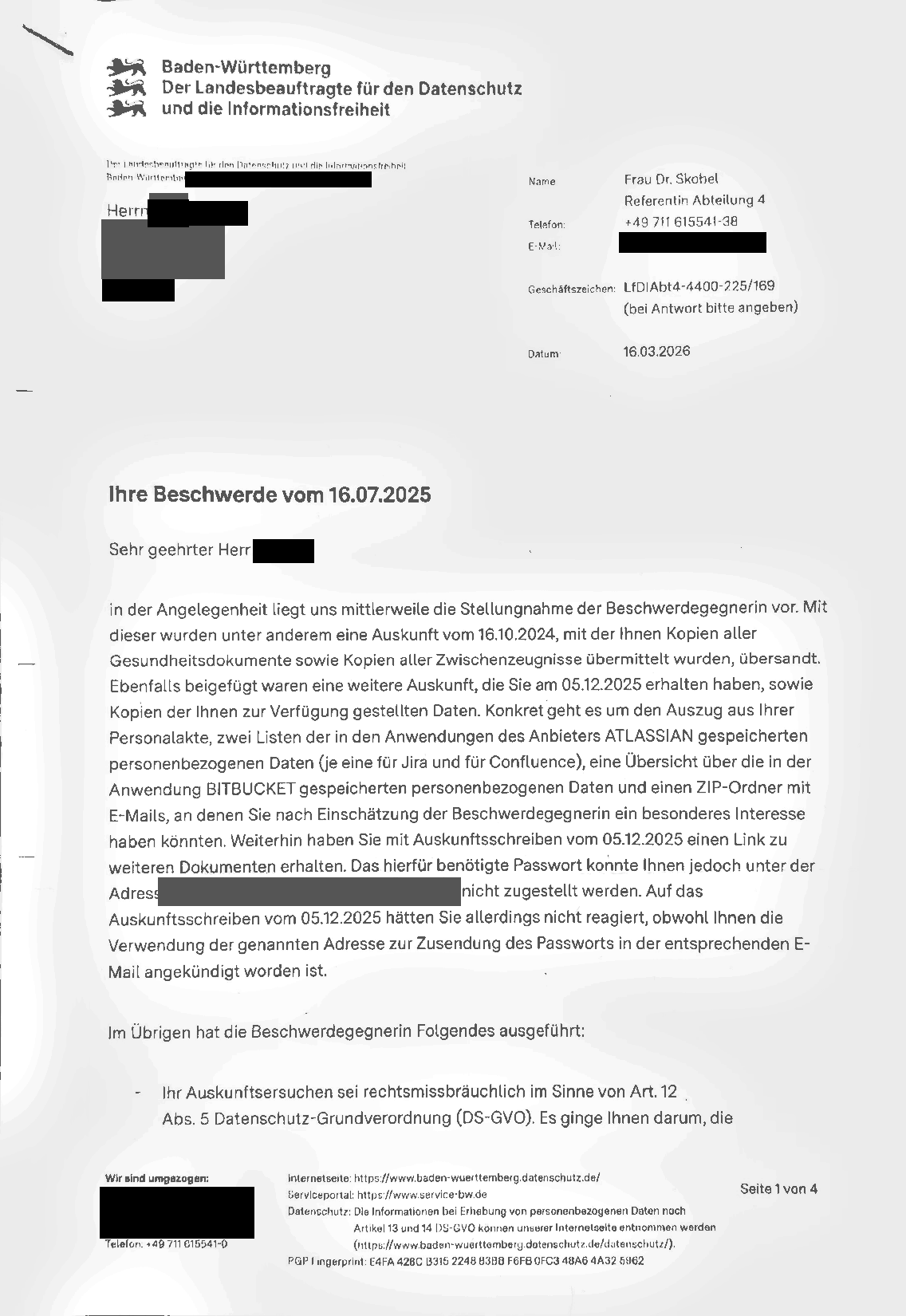
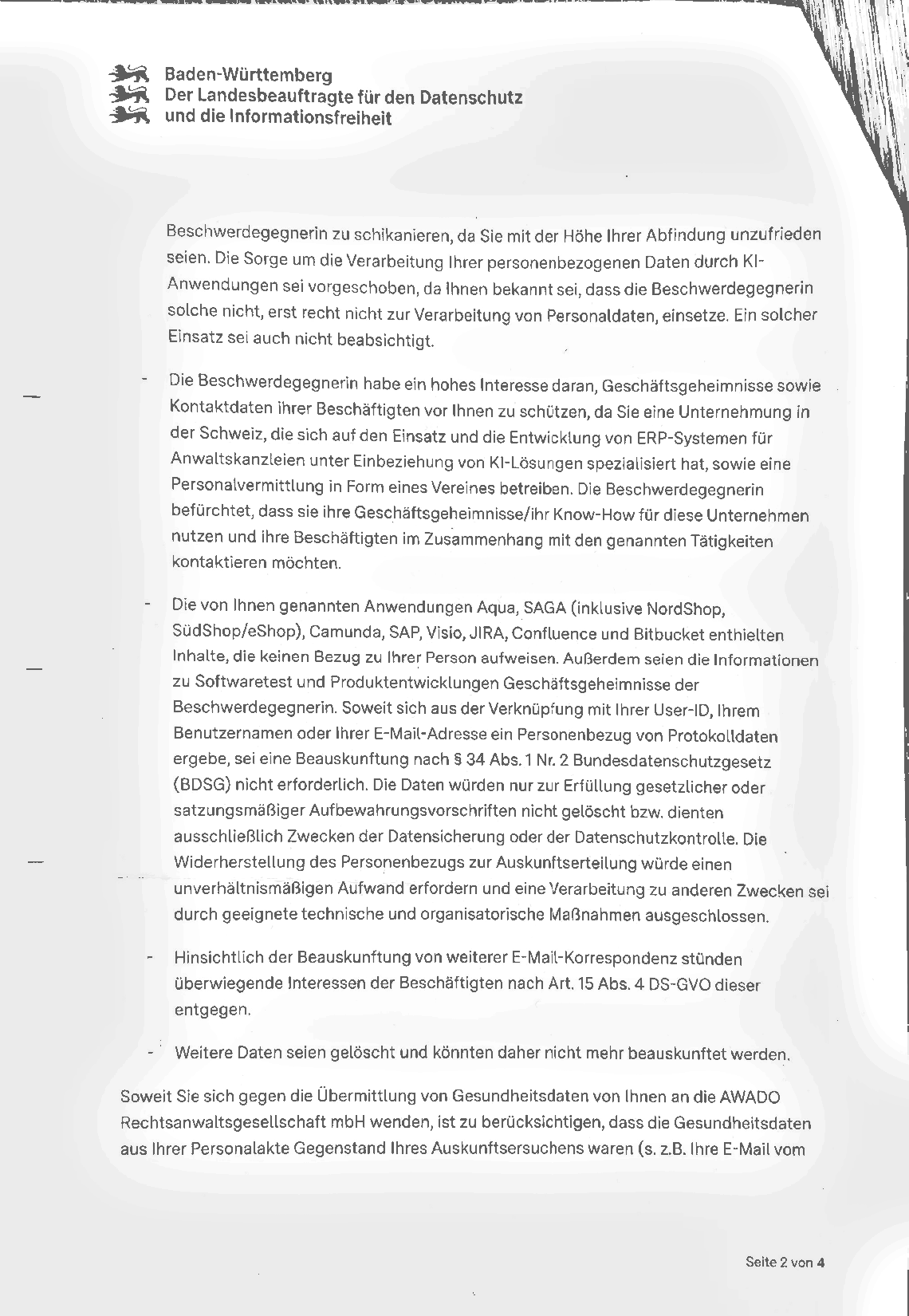
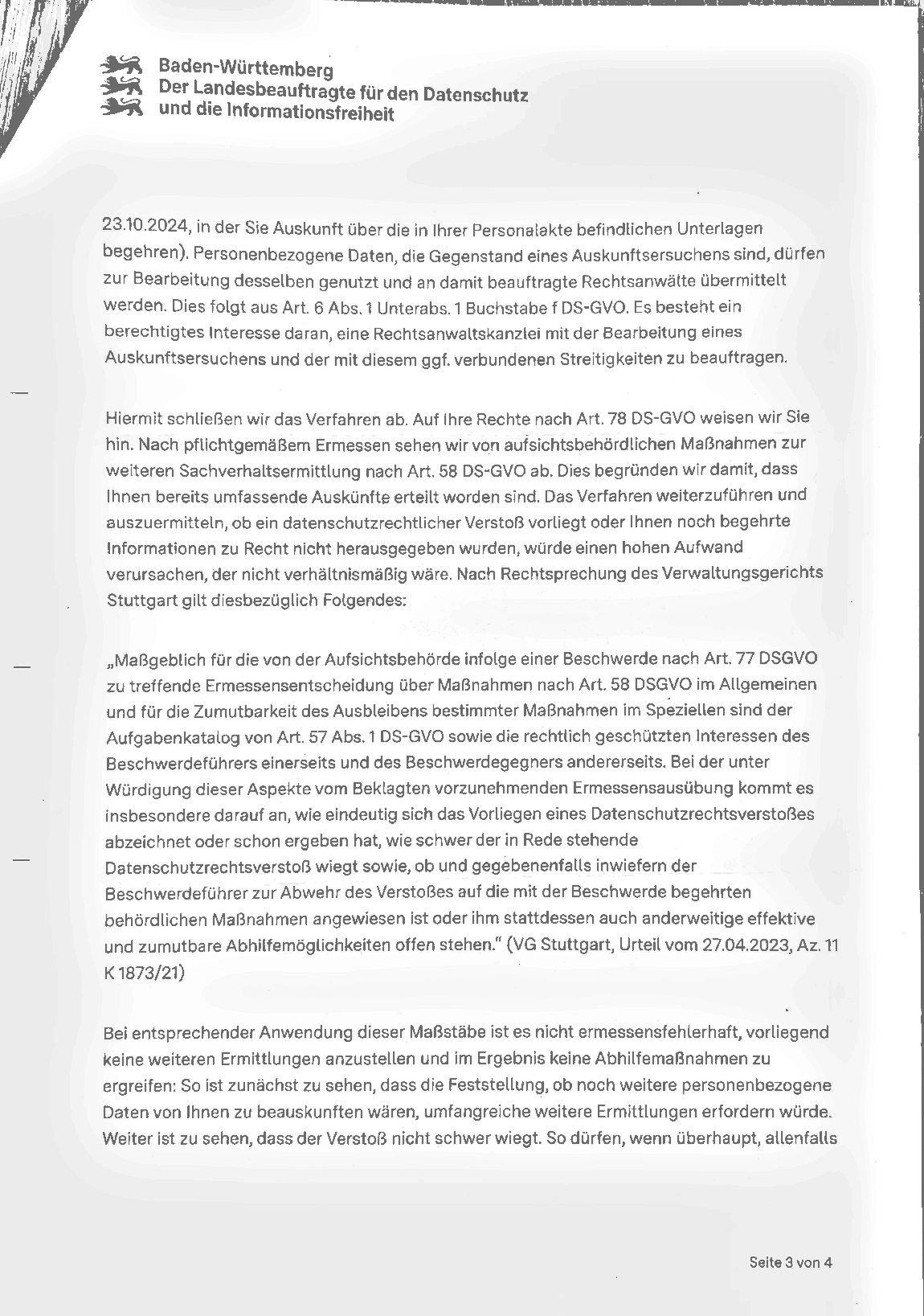
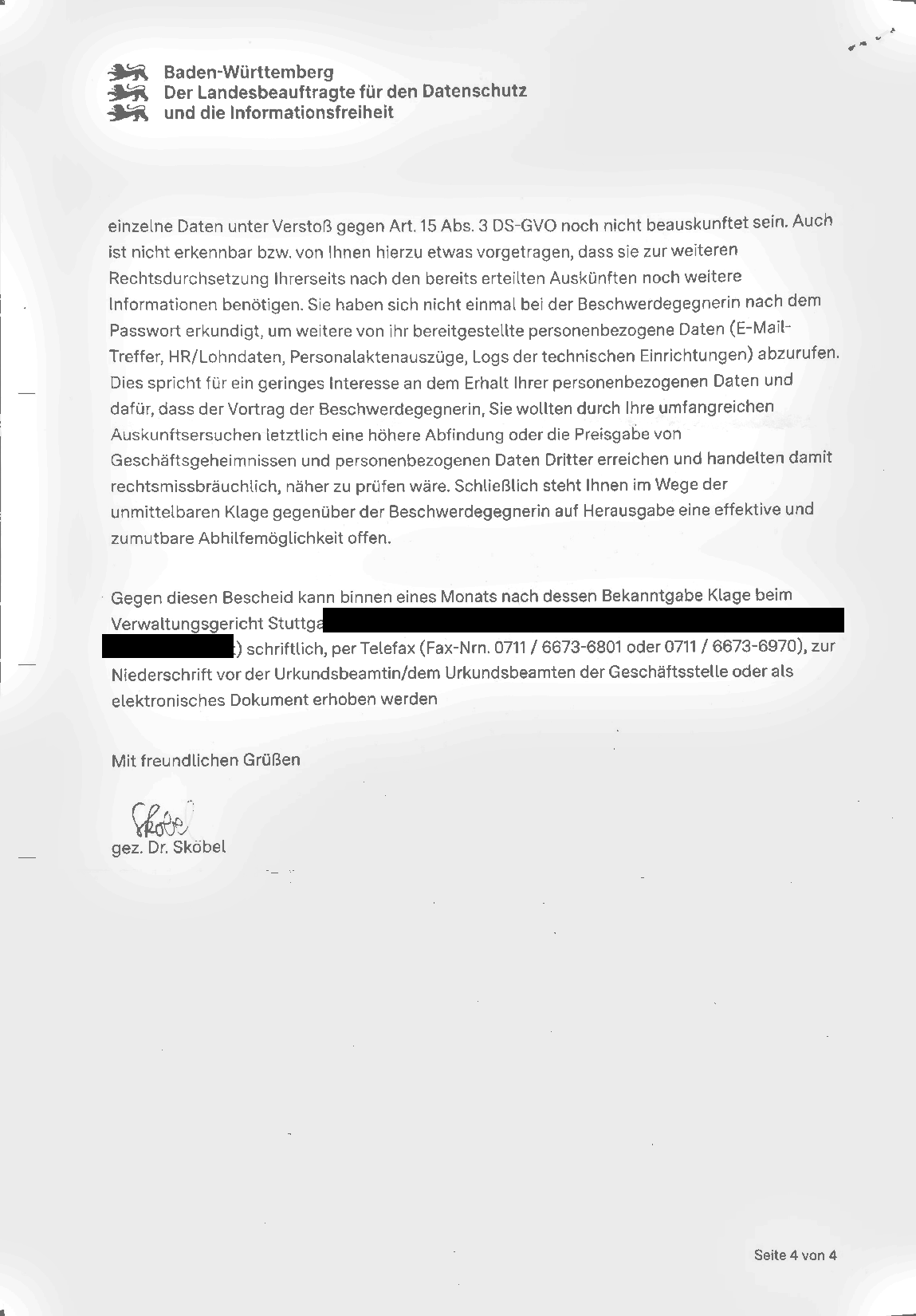
🇬🇧 Read transcript in English by Claude
Working translation — AI-assisted (Claude). Provided for international readers. The German original above is authoritative; this is not a certified translation. Emphasis added. Passages in square brackets are summarised.
Decision closing the complaint procedure — 16 March 2026
State Commissioner for Data Protection and Freedom of Information Baden-Württemberg · Dr. Skobel, Officer, Division 4 · Ref. LfDIAbt4-4400-225/169
Re: Your complaint of 16 July 2025
The respondent's statement is now available. It included a disclosure of 16.10.2024 (copies of all health documents and interim references), a further disclosure received by you on 05.12.2025, and copies of the data provided: an extract from your personnel file, two lists of personal data stored in the ATLASSIAN applications (Jira and Confluence), an overview of data stored in BITBUCKET, and a ZIP folder with e-mails. With the disclosure letter of 05.12.2025 you also received a link to further documents. However, the password required for this could not be delivered to the address “[redacted]”. You did not react to the disclosure letter of 05.12.2025, although the use of that address for sending the password had been announced to you.
The respondent further submitted:
- Your access request is abusive within the meaning of Art. 12(5) GDPR. Your aim is to harass the respondent because you are dissatisfied with the amount of your severance payment. Your concern about processing by AI applications is a pretext, since you know that the respondent does not use such systems, let alone for processing personnel data, and does not intend to.
- The respondent has a high interest in protecting its business secrets and the contact details of its employees from you, because you operate a company in Switzerland specialising in the deployment and development of ERP systems for law firms including AI solutions, as well as a recruitment agency in the form of an association. The respondent fears that you would use its business secrets / know-how for these ventures and contact its employees.
- The applications you named (Aqua, SAGA including NordShop, SüdShop/eShop, Camunda, SAP, Visio, JIRA, Confluence, Bitbucket) contain no content relating to your person. Information on software testing and product development are, moreover, business secrets of the respondent. Insofar as a personal reference of log data results from linkage with your user ID, username or e-mail address, disclosure is not required under § 34(1) no. 2 BDSG: restoring the personal reference for the purpose of disclosure would require disproportionate effort.
- As regards further e-mail correspondence, overriding interests of employees under Art. 15(4) GDPR preclude disclosure.
- Further data have been deleted and can therefore no longer be disclosed.
As to your objection to the transfer of your health data to the law firm AWADO: the health data from your personnel file were the subject of your access request. Personal data that are the subject of an access request may be used to process it and transmitted to the lawyers instructed. This follows from Art. 6(1)(1)(f) GDPR. There is a legitimate interest in instructing a law firm to handle an access request and any related disputes.
We hereby close the proceedings. We draw your attention to your rights under Art. 78 GDPR. In the exercise of our dutiful discretion we refrain from supervisory measures for further investigation of the facts under Art. 58 GDPR. We justify this on the ground that comprehensive information has already been provided to you. Continuing the proceedings and investigating whether a data-protection infringement exists, or whether information you seek was rightly withheld, would cause a high effort which would not be proportionate.
[The decision then quotes VG Stuttgart, judgment of 27.04.2023, 11 K 1873/21, on the exercise of discretion.]
Applying those standards, it is not an error of discretion to make no further investigations and, as a result, take no remedial measures: establishing whether further personal data of yours would have to be disclosed would require extensive further investigation. Further, the infringement is not serious. At most individual items of data may not yet have been disclosed in breach of Art. 15(3) GDPR. Nor is it apparent — nor have you submitted anything on this — that, after the disclosures already given, you need further information for the further enforcement of your rights. You did not even ask the respondent for the password in order to retrieve further personal data made available by it (e-mail hits, HR/payroll data, personnel file extracts, logs of technical facilities). This indicates a low interest in obtaining your personal data and indicates that the respondent's submission — that through your extensive access requests you ultimately sought a higher severance payment or the disclosure of business secrets and personal data of third parties, and thus acted abusively — would merit closer examination. Finally, a direct action against the respondent for disclosure is an effective and reasonable remedy available to you.
Legal remedy: action before the Administrative Court of Stuttgart within one month.
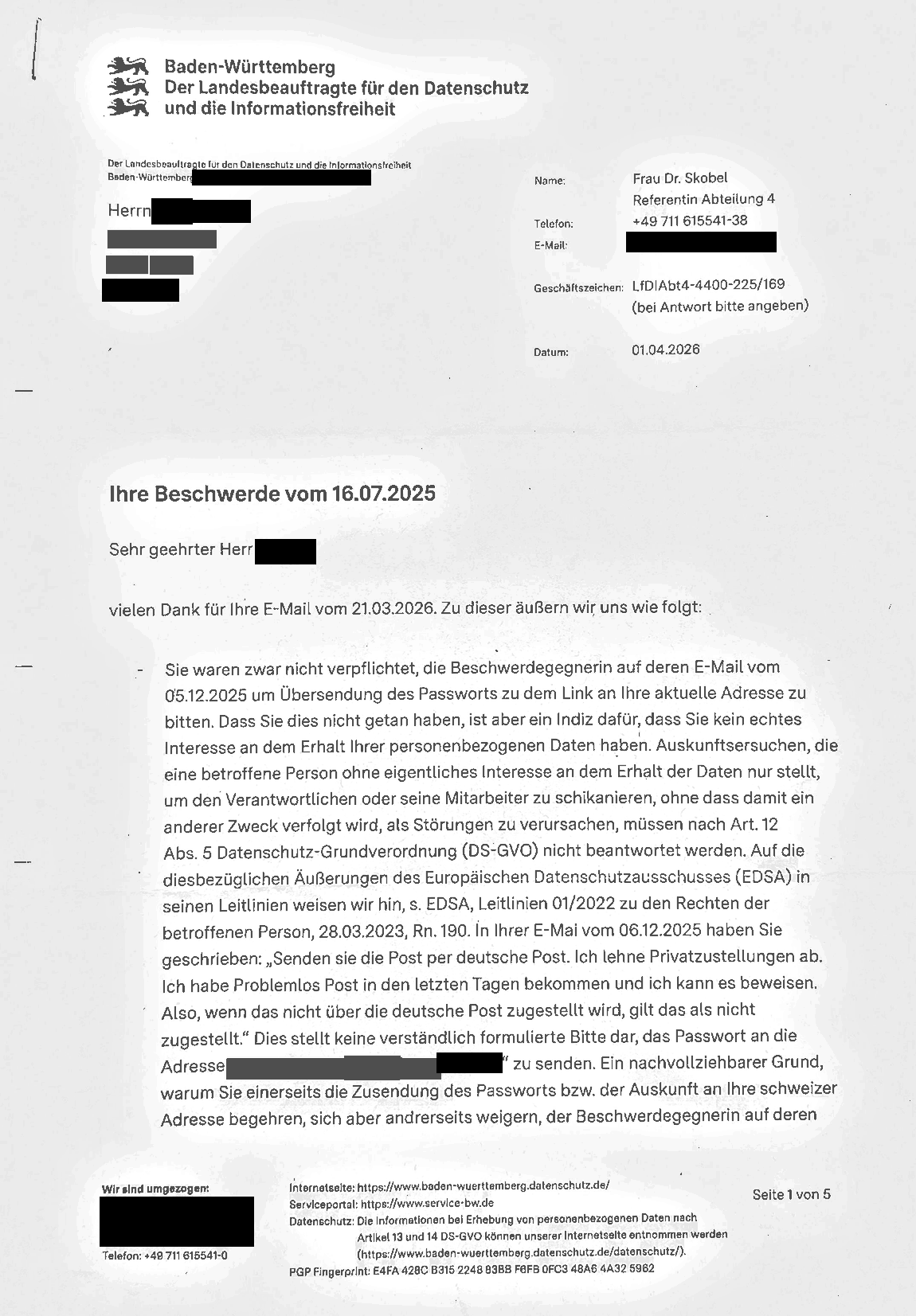
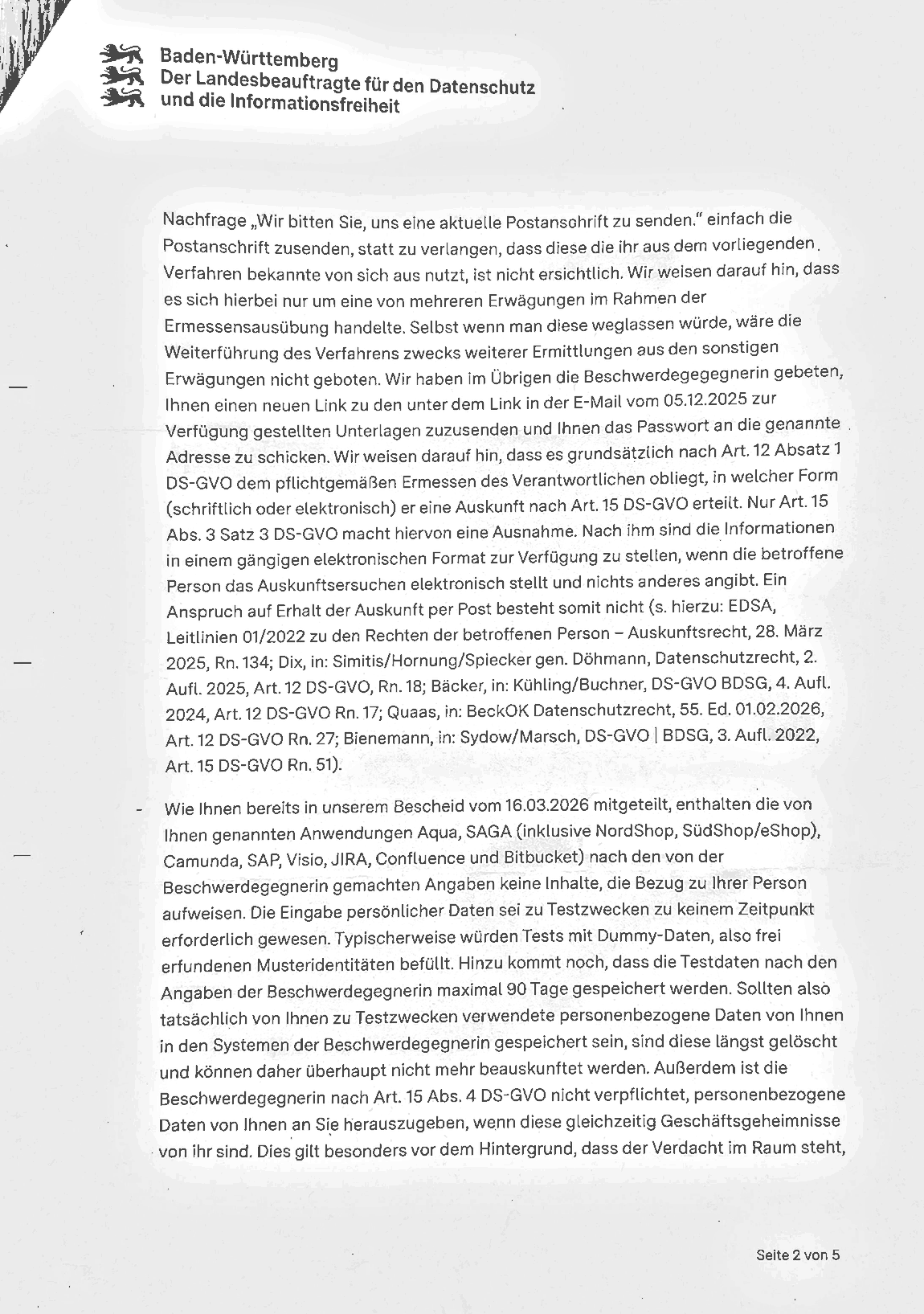
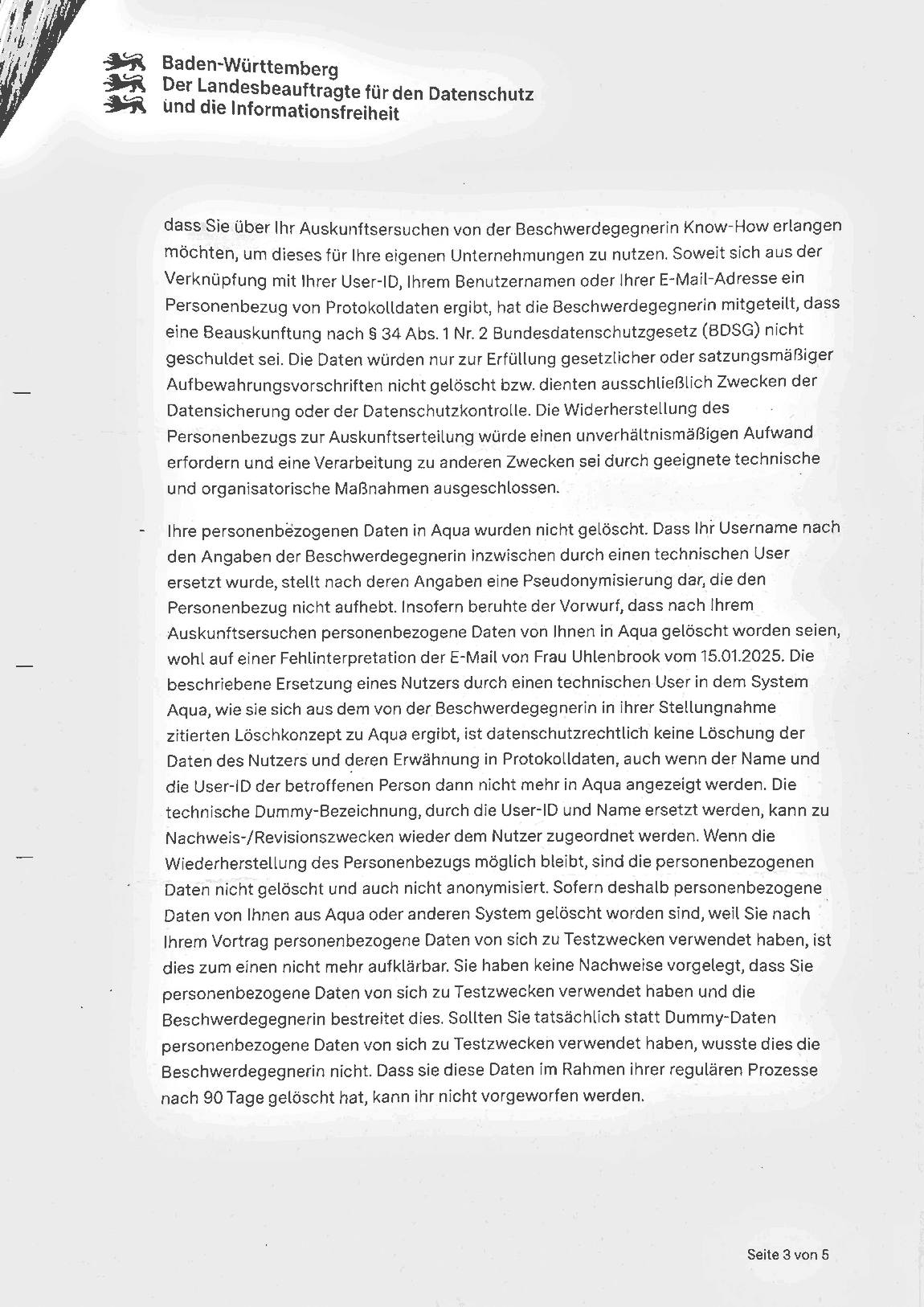
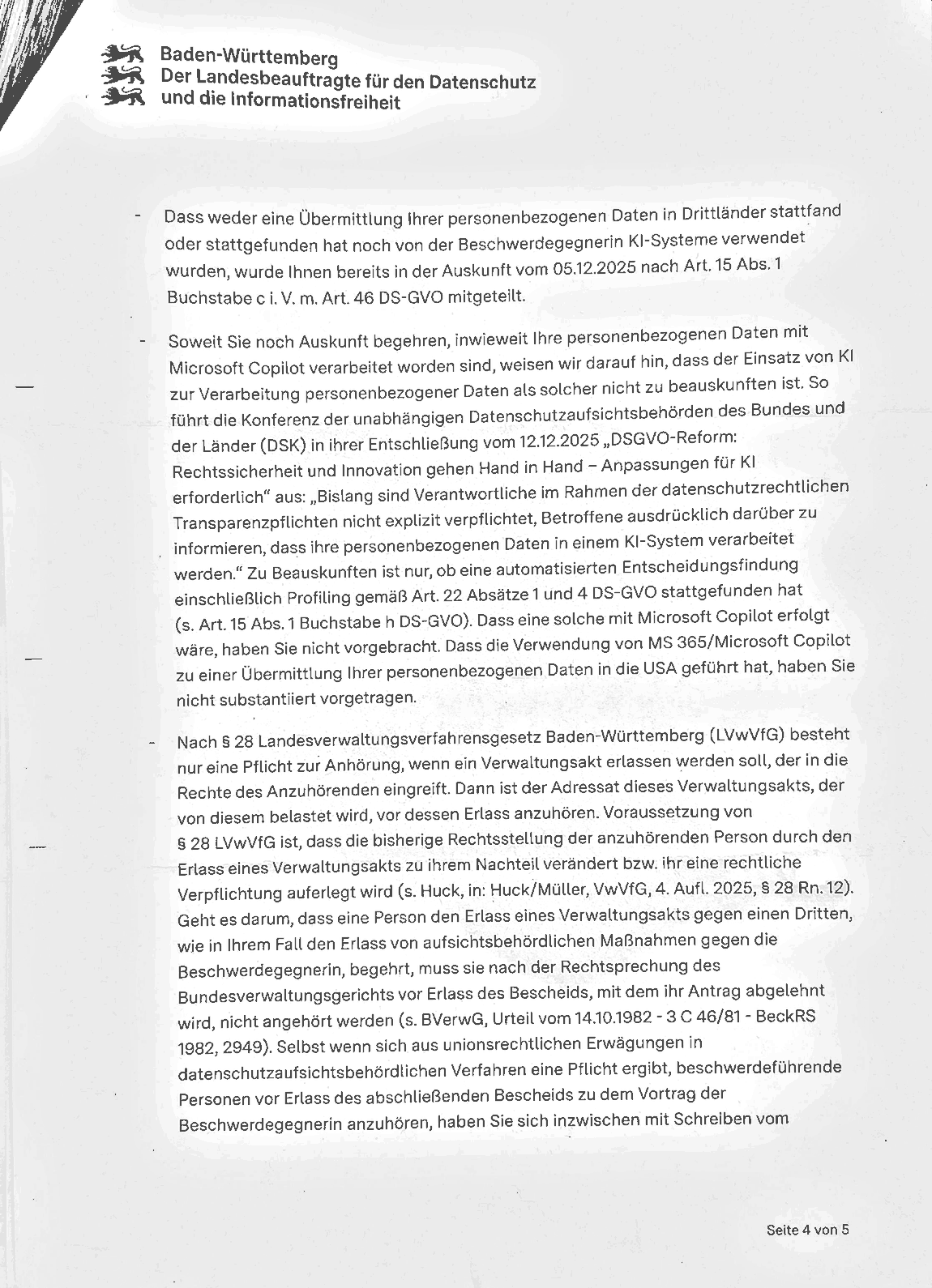
Letter of 01.04.2026
Dr. Skobel · 5 pages · reply to the objection · administrative procedure (before the action was filed)
Substantiates Allegation 2 · Allegation 3 · Allegation 8 · Allegation 13 · Allegation 18 · Allegation 22
📄 View document (5 pages)
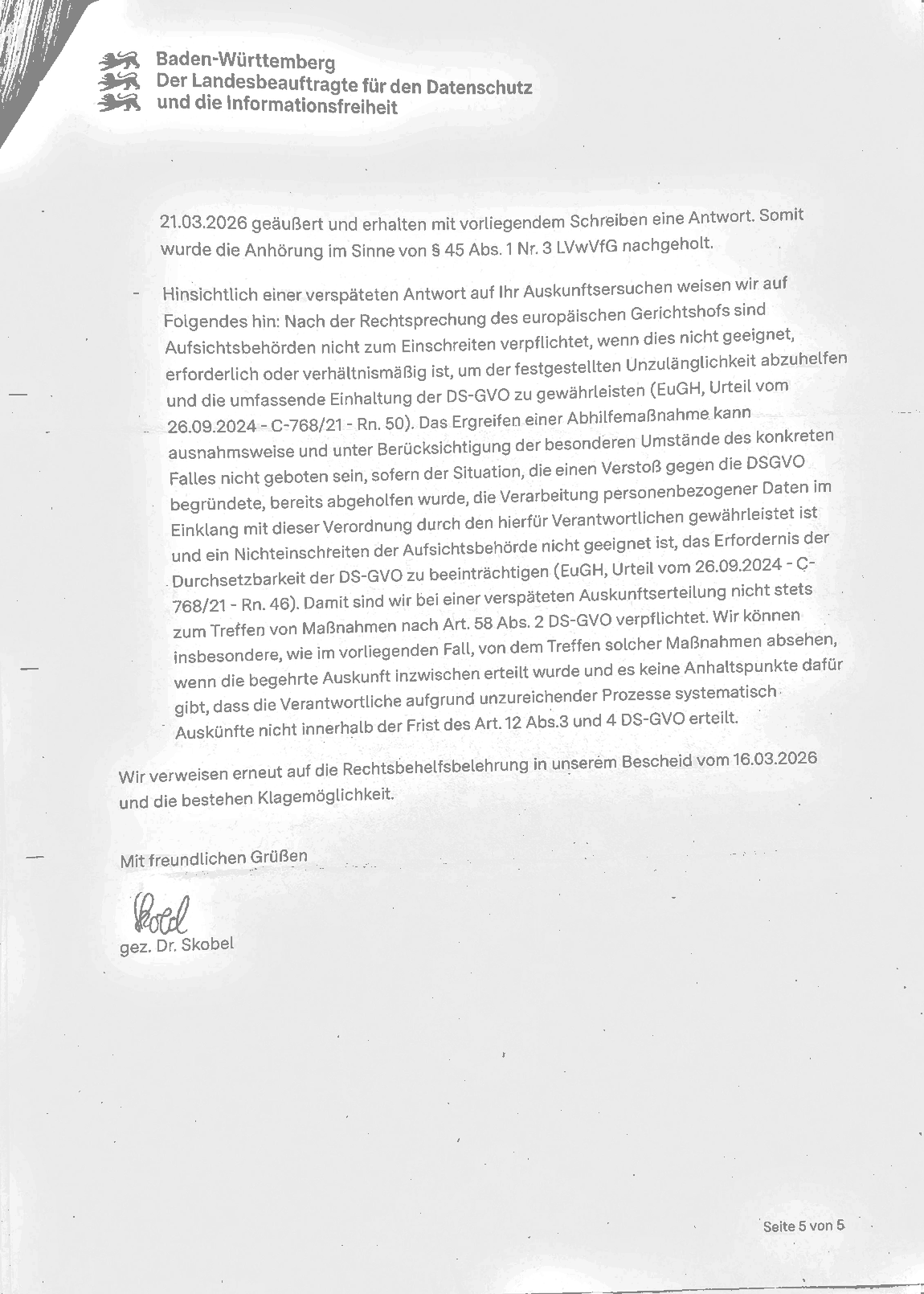
🇬🇧 Read transcript in English by Claude
Working translation — AI-assisted (Claude). Provided for international readers. The German original above is authoritative; this is not a certified translation. Emphasis added. Passages in square brackets are summarised.
Letter of 1 April 2026 · Dr. Skobel, Officer, Division 4 · Ref. LfDIAbt4-4400-225/169
Re: Your complaint of 16 July 2025 — reply to your e-mail of 21 March 2026
- You were indeed not obliged to ask the respondent, in response to its e-mail of 05.12.2025, to send the password for the link to your current address. That you did not do so is, however, an indication that you have no genuine interest in obtaining your personal data. Access requests which a data subject makes without any actual interest in obtaining the data, merely in order to harass the controller or its employees, without pursuing any purpose other than causing disruption, need not be answered under Art. 12(5) GDPR (see EDPB Guidelines 01/2022 on data subject rights, 28.03.2023, para. 190).
- [The letter then quotes the complainant's e-mail of 06.12.2025 demanding delivery by German postal service and states that this was not a comprehensible request to send the password to his Swiss address.]
- We point out that under Art. 12(1) GDPR it is generally at the controller's dutiful discretion in which form (written or electronic) it provides information under Art. 15 GDPR. Only Art. 15(3) sentence 3 GDPR makes an exception to this. Under that provision the information is to be made available in a commonly used electronic format where the data subject makes the request electronically and does not indicate otherwise. There is therefore no right to receive the information by post.
- As already stated in our decision of 16.03.2026, the applications you named contain — according to the information given by the respondent — no content relating to your person. The entry of personal data was at no time necessary for testing purposes; tests are typically populated with dummy data. In addition, test data are stored for a maximum of 90 days according to the respondent. So if personal data of yours used for testing were in fact stored in the respondent's systems, they are long since deleted and can therefore no longer be disclosed at all. Moreover, under Art. 15(4) GDPR the respondent is not obliged to release personal data of yours to you if these are at the same time business secrets of the respondent. This applies particularly against the background that the suspicion stands in the room that you wish, via your access request, to obtain know-how from the respondent in order to use it for your own ventures.
- Your personal data in “Aqua” were not deleted. That your username has, according to the respondent, meanwhile been replaced by a technical user constitutes, according to the respondent, a pseudonymisation which does not remove the personal reference. The technical dummy designation replacing user ID and name can be re-assigned to the user for verification/audit purposes. If restoration of the personal reference remains possible, the personal data are neither deleted nor anonymised. Insofar as personal data of yours were deleted from Aqua or other systems because — on your account — you used personal data of your own for testing, this is firstly no longer ascertainable. You have submitted no evidence that you did so, and the respondent disputes it. That it deleted these data after 90 days in the course of its regular processes cannot be held against it.
- That neither a transfer of your personal data to third countries took place nor AI systems were used by the respondent was already communicated to you in the disclosure of 05.12.2025.
- Insofar as you still seek information on the extent to which your personal data were processed with Microsoft Copilot, we point out that the use of AI for the processing of personal data as such is not subject to disclosure (citing the resolution of the German Data Protection Conference of 12.12.2025). Only whether automated decision-making including profiling under Art. 22(1) and (4) GDPR took place must be disclosed (Art. 15(1)(h)). You have not submitted that such occurred with Microsoft Copilot. That the use of MS 365 / Microsoft Copilot led to a transfer of your personal data to the USA you have not substantiated.
- [The letter closes with an argument that no hearing was required under § 28 LVwVfG.]
Letter of 15.05.2026
Head of department Schweizer · 2 pages · motion for bias · administrative procedure (before the action was filed)
Substantiates Allegation 8 · Allegation 19 · Allegation 20
📄 View document (2 pages)
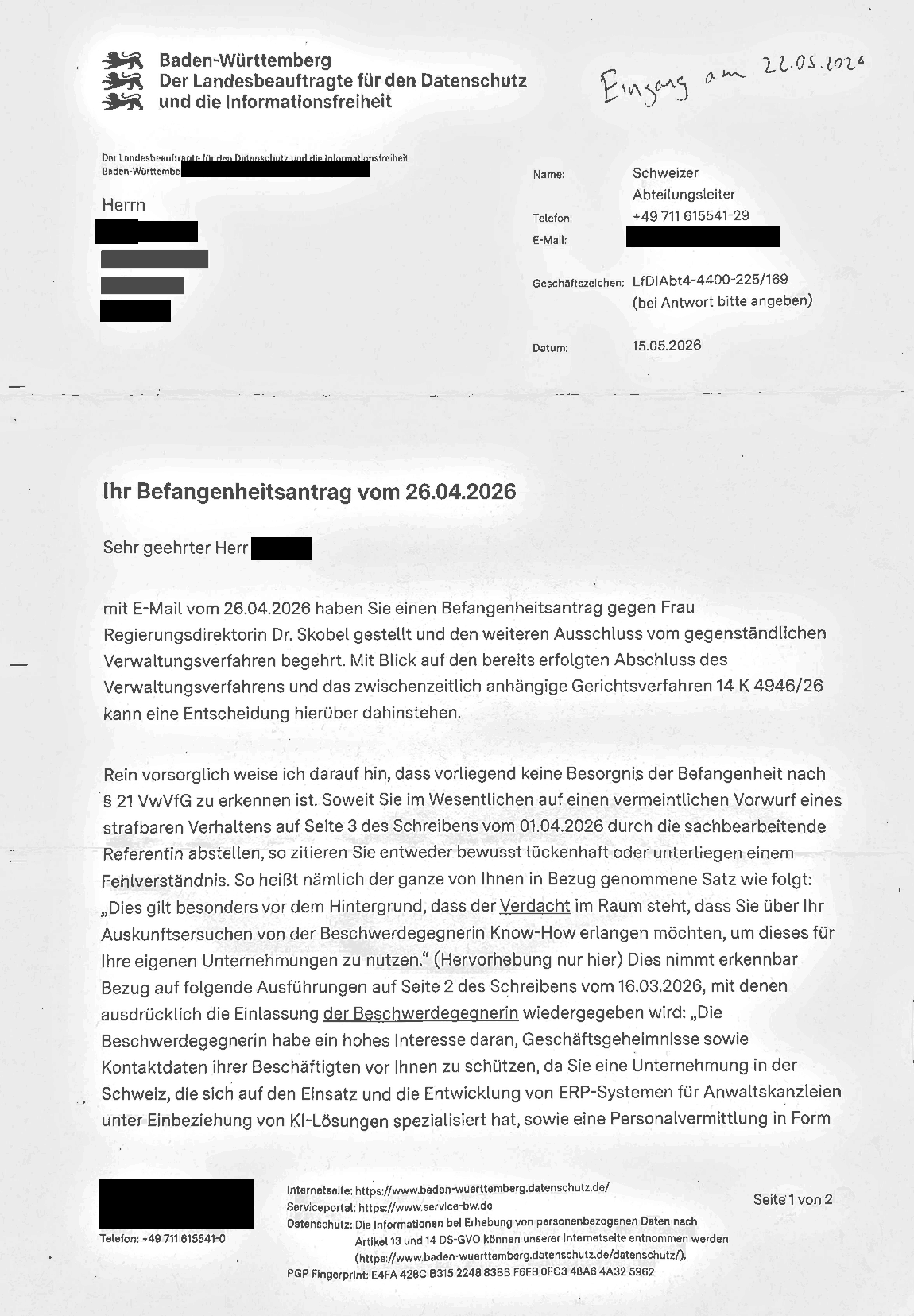
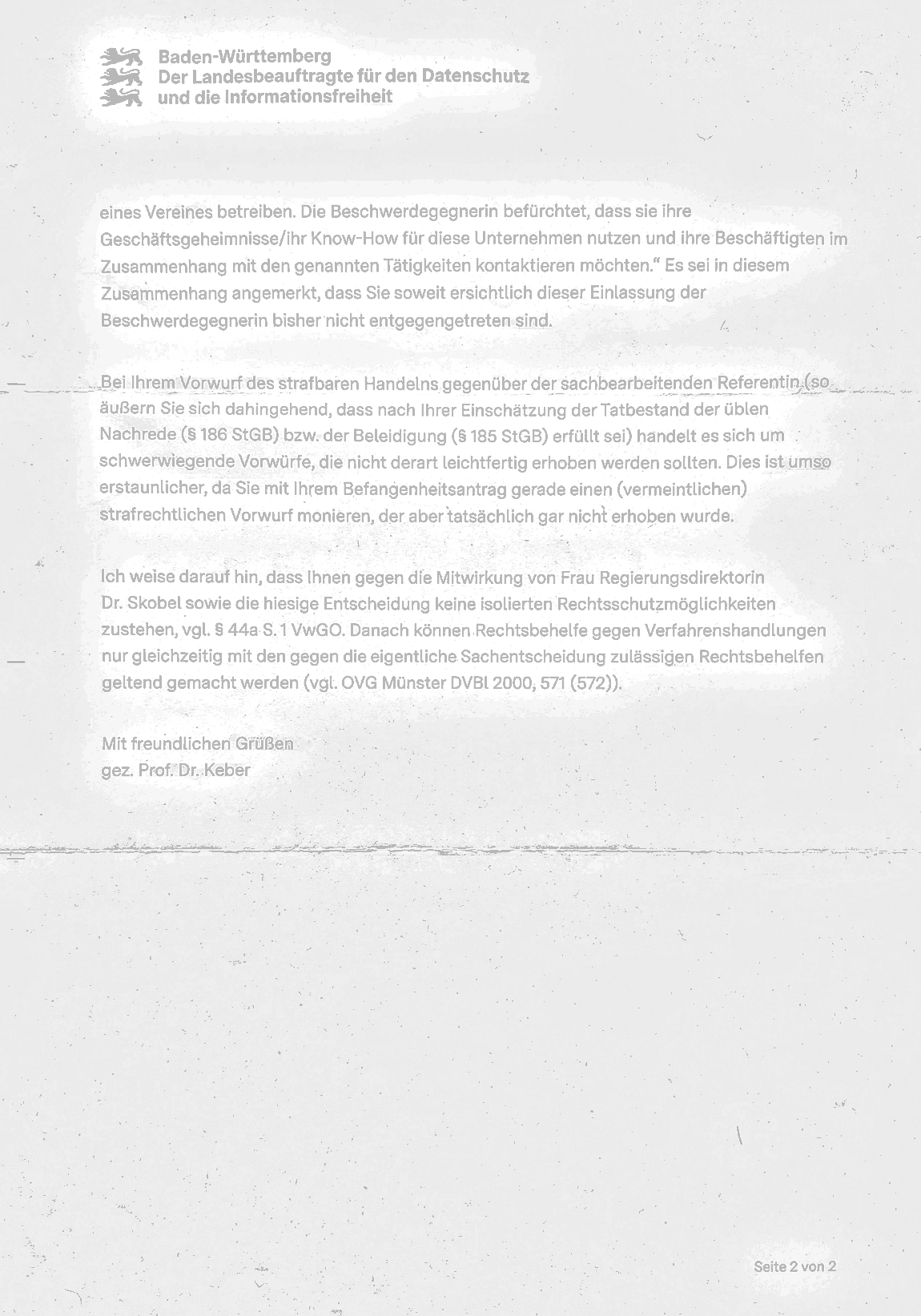
🇬🇧 Read transcript in English by Claude
Working translation — AI-assisted (Claude). Provided for international readers. The German original above is authoritative; this is not a certified translation. Emphasis added. Passages in square brackets are summarised.
Letter of 15 May 2026 · Head of Division “Schweizer” · Ref. LfDIAbt4-4400-225/169
Re: Your motion of bias of 26 April 2026
By e-mail of 26.04.2026 you filed a motion of bias against Regierungsdirektorin Dr. Skobel and sought her further exclusion from the administrative proceedings. In view of the already completed administrative proceedings and the court proceedings 14 K 4946/26 now pending, a decision on this can be left open.
Purely as a precaution I point out that no concern of bias within the meaning of § 21 VwVfG is apparent here. Insofar as you essentially rely on an alleged accusation of criminal conduct on page 3 of the letter of 01.04.2026 by the case-handling officer, you either quote deliberately incompletely or are subject to a misunderstanding. The full sentence you refer to reads:
“This applies particularly against the background that the suspicion stands in the room that you wish, via your access request, to obtain know-how from the respondent in order to use it for your own ventures.” (emphasis added here)
This evidently refers to the following statements on page 2 of the decision of 16.03.2026, with which the submission of the respondent is expressly reproduced:
“The respondent has a high interest in protecting business secrets and the contact details of its employees from you, because you operate a company in Switzerland specialising in the deployment and development of ERP systems for law firms including AI solutions, as well as a recruitment agency in the form of an association. The respondent fears that you would use its business secrets / know-how for these ventures and contact its employees in connection with those activities.”
It should be noted in this connection that, as far as can be seen, you have not so far contested this submission of the respondent.
[The letter continues regarding the complainant's assertion that the officer's conduct fulfils the offence of defamation (§ 186 StGB) / insult.]
reply to the application of 08.07.2026
Dr. Eva Skobel · 12 pages · interim proceedings 14 K 6435/26 · court proceedings (after the action was filed)
Substantiates Allegation 9 · Allegation 10
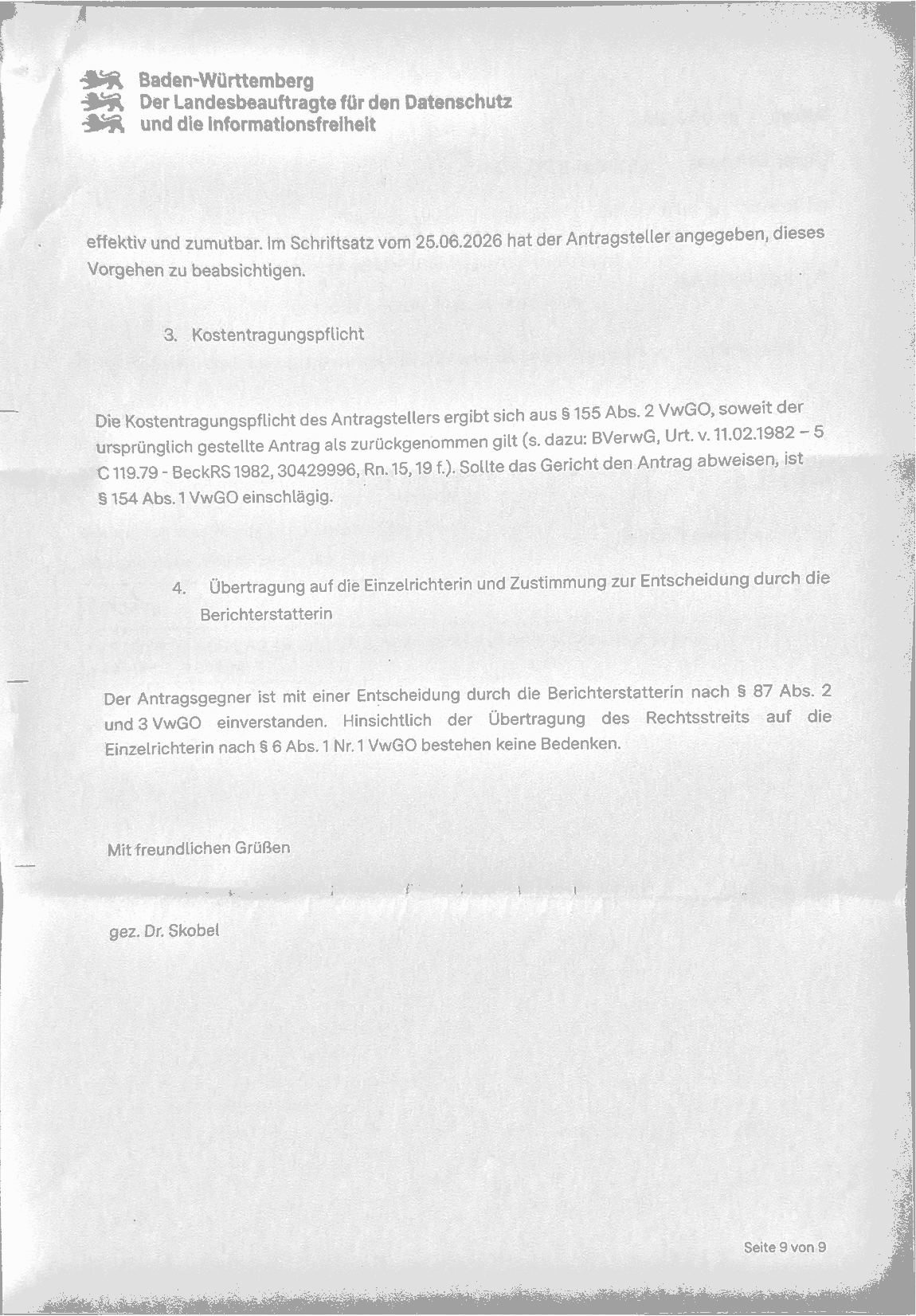
📄 View document (12 pages)
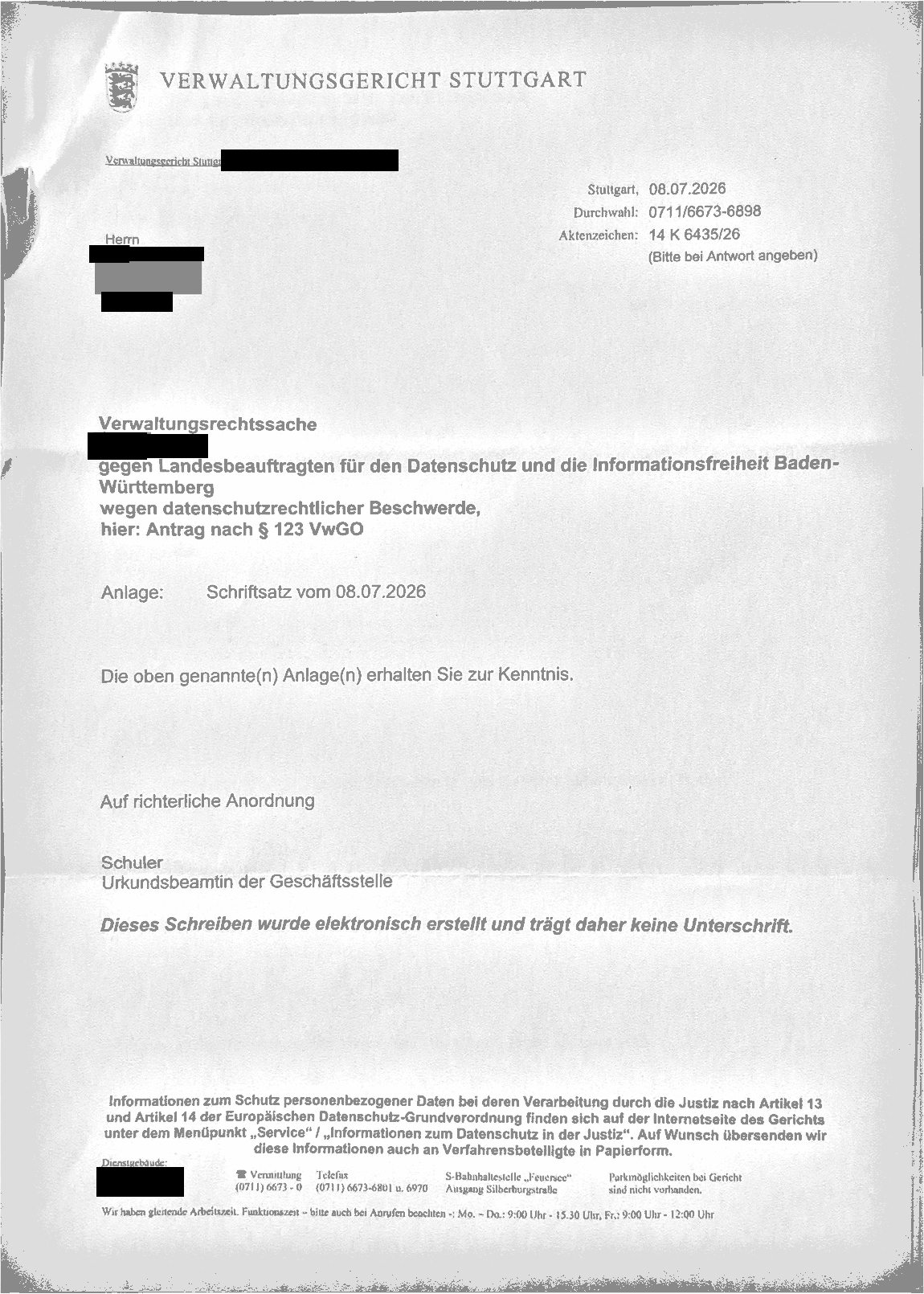
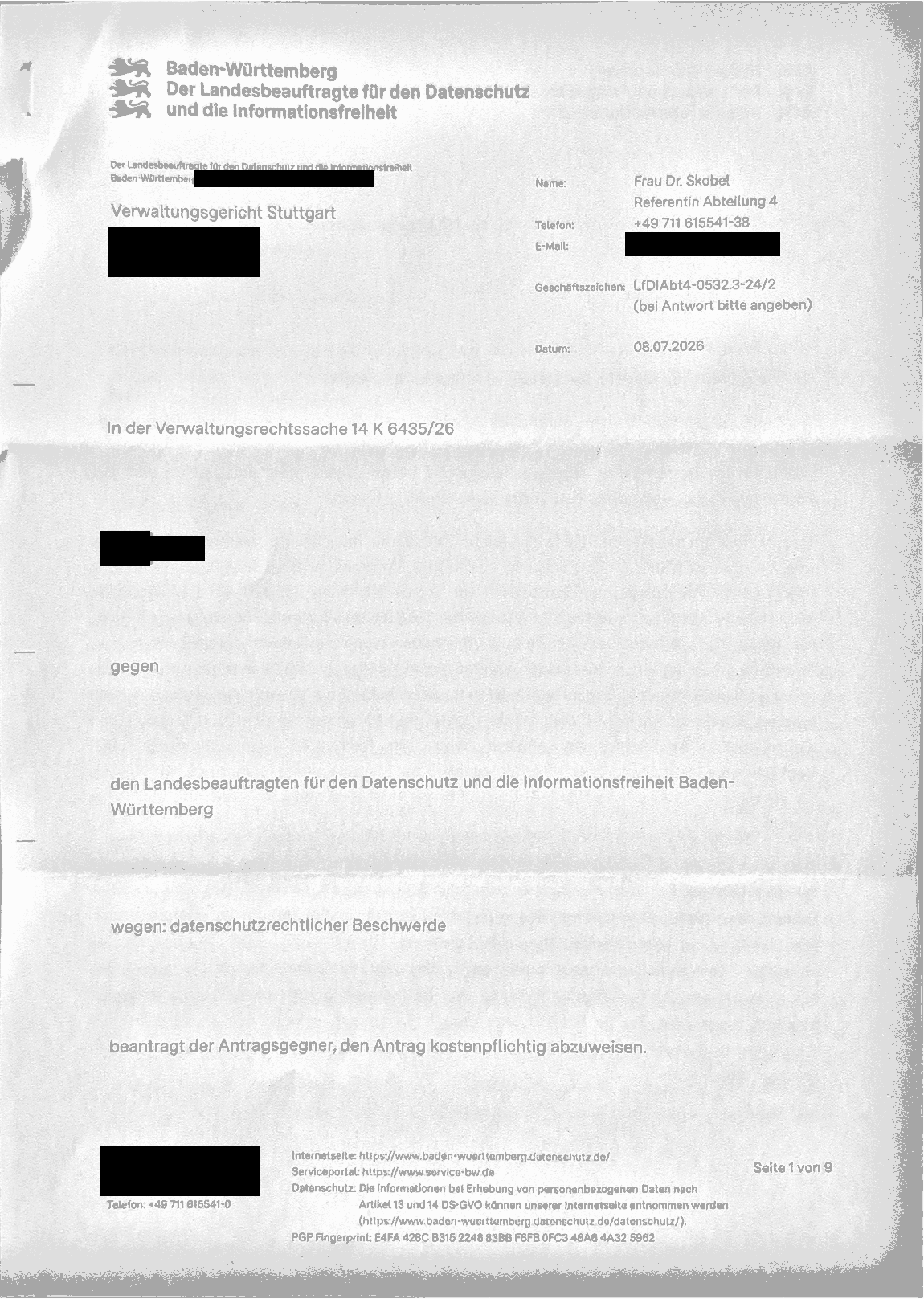
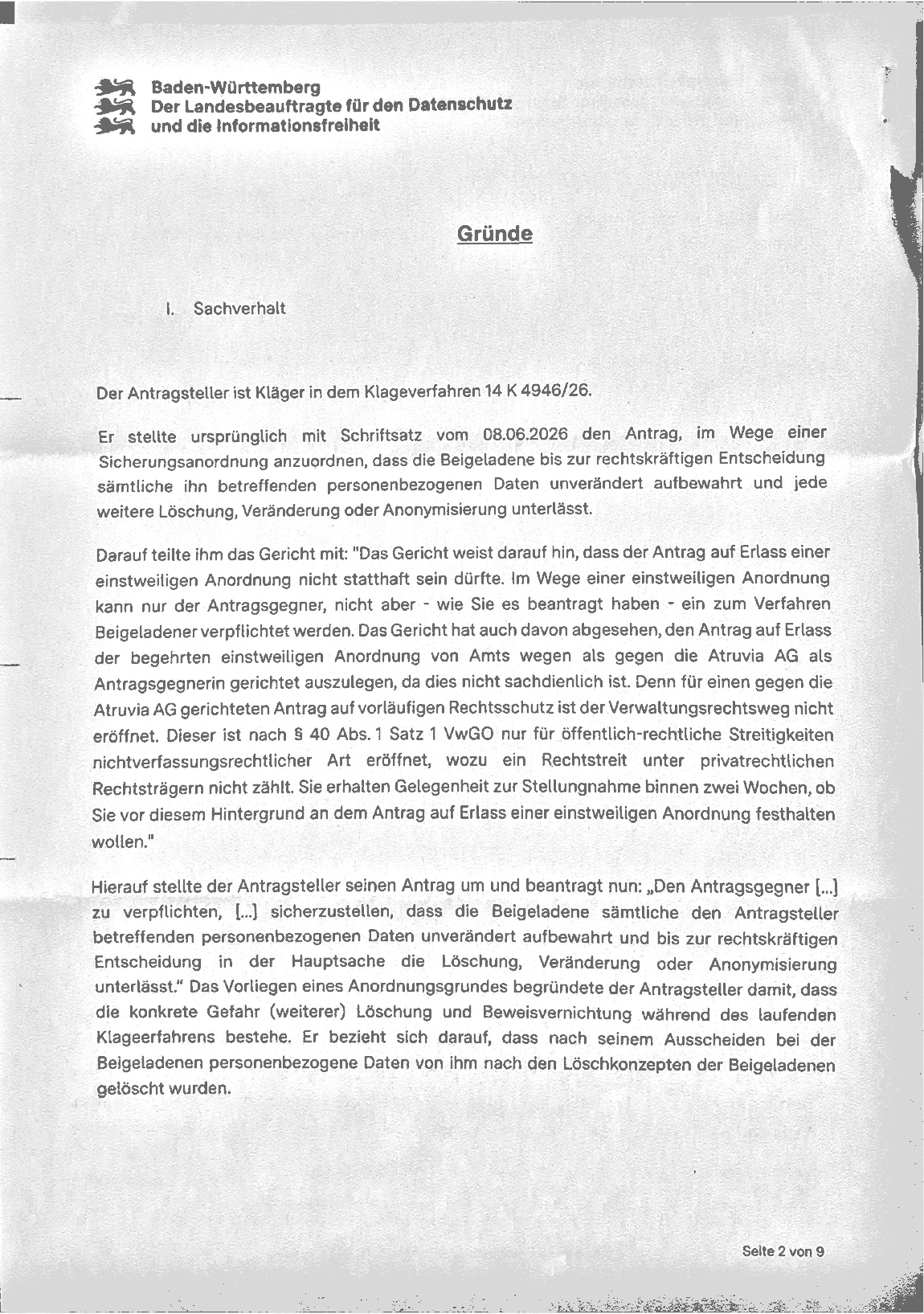
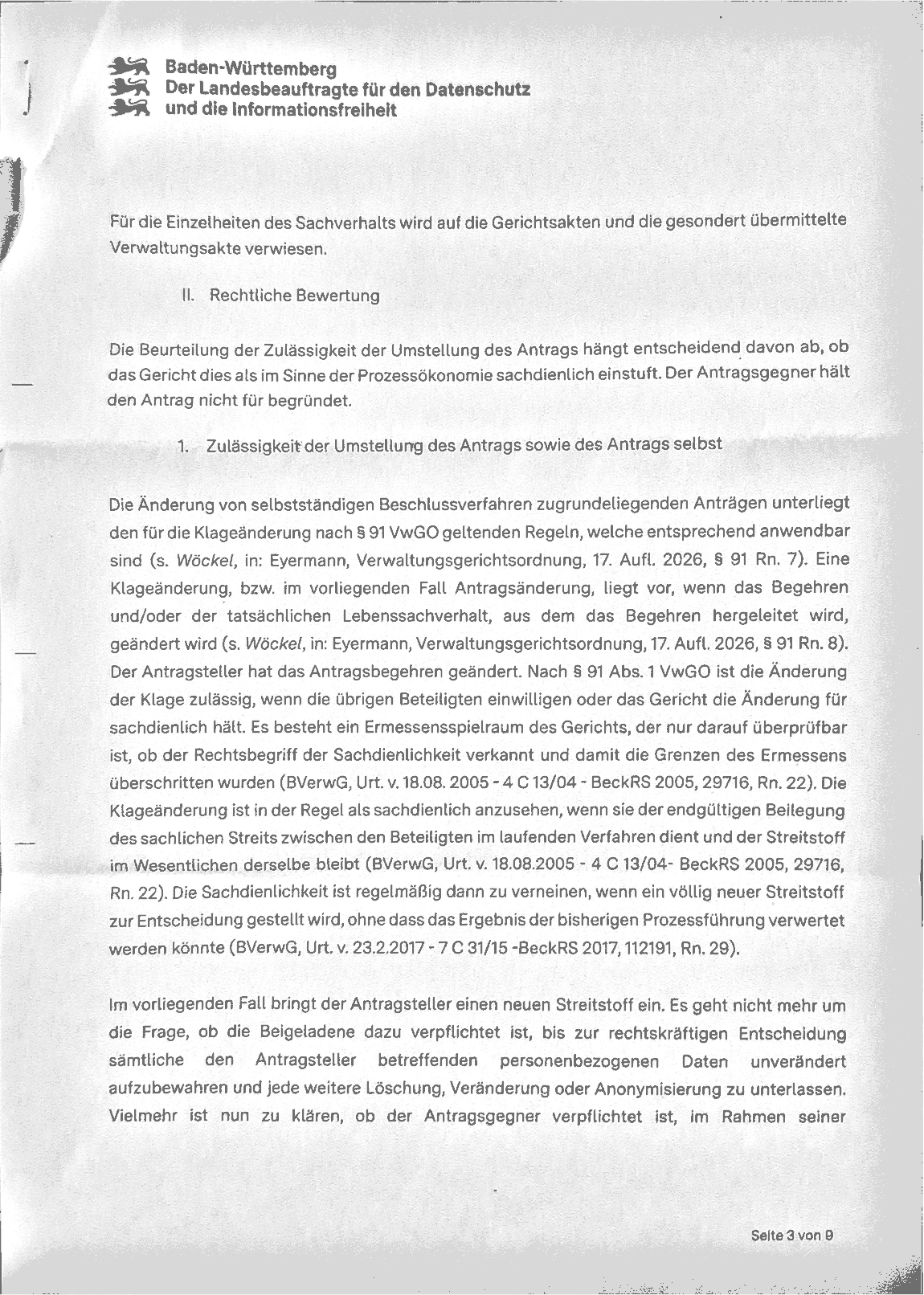
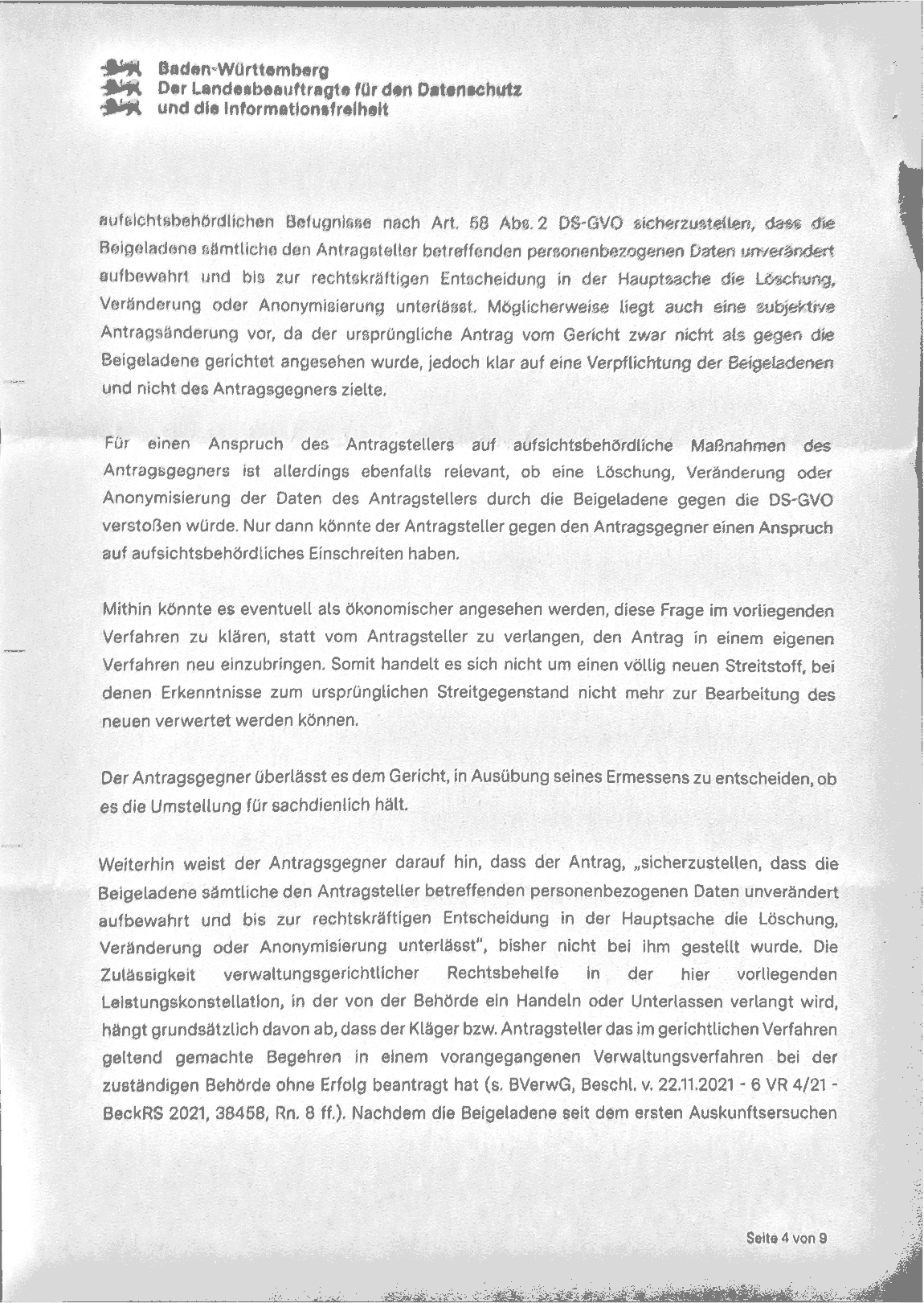
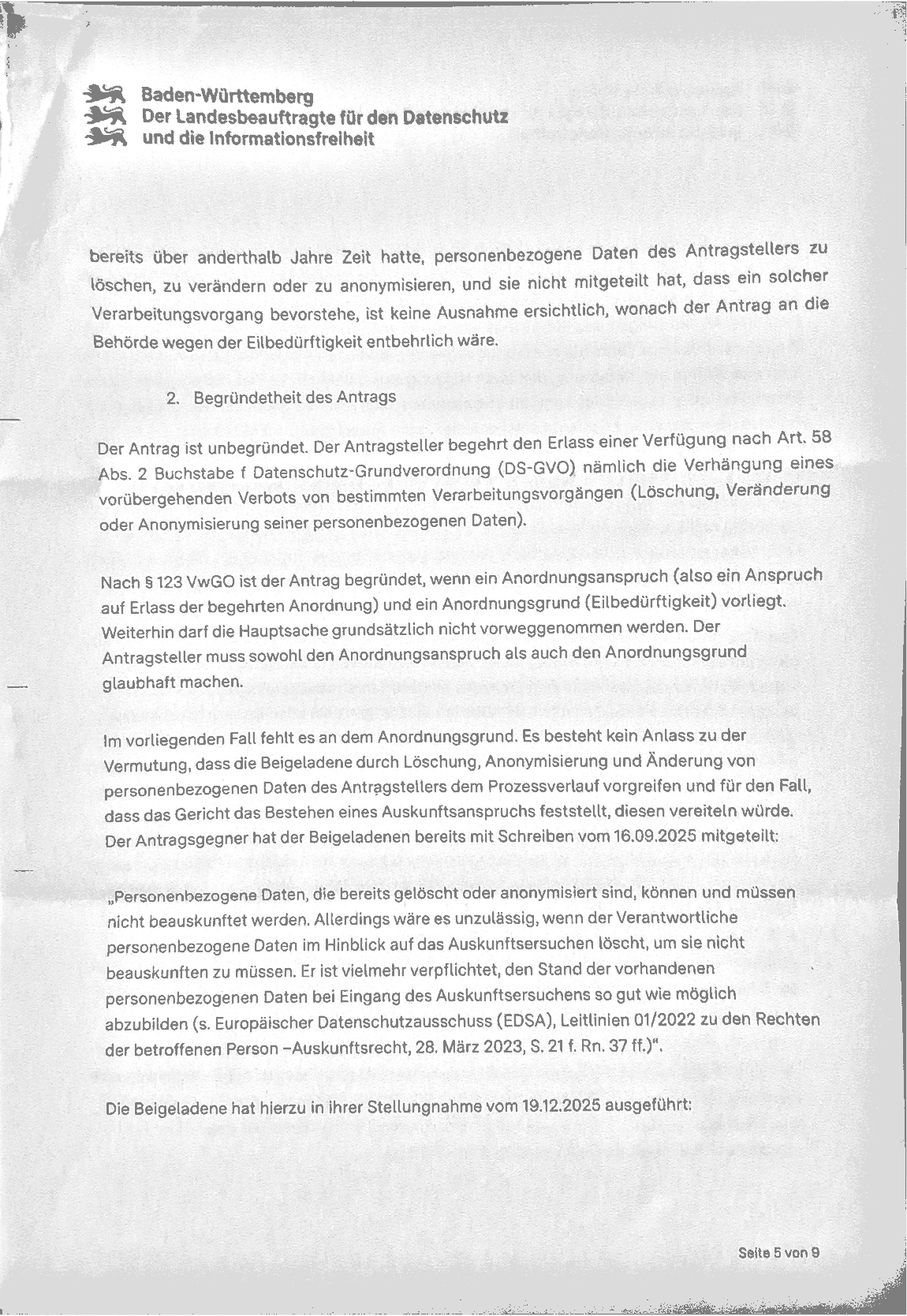
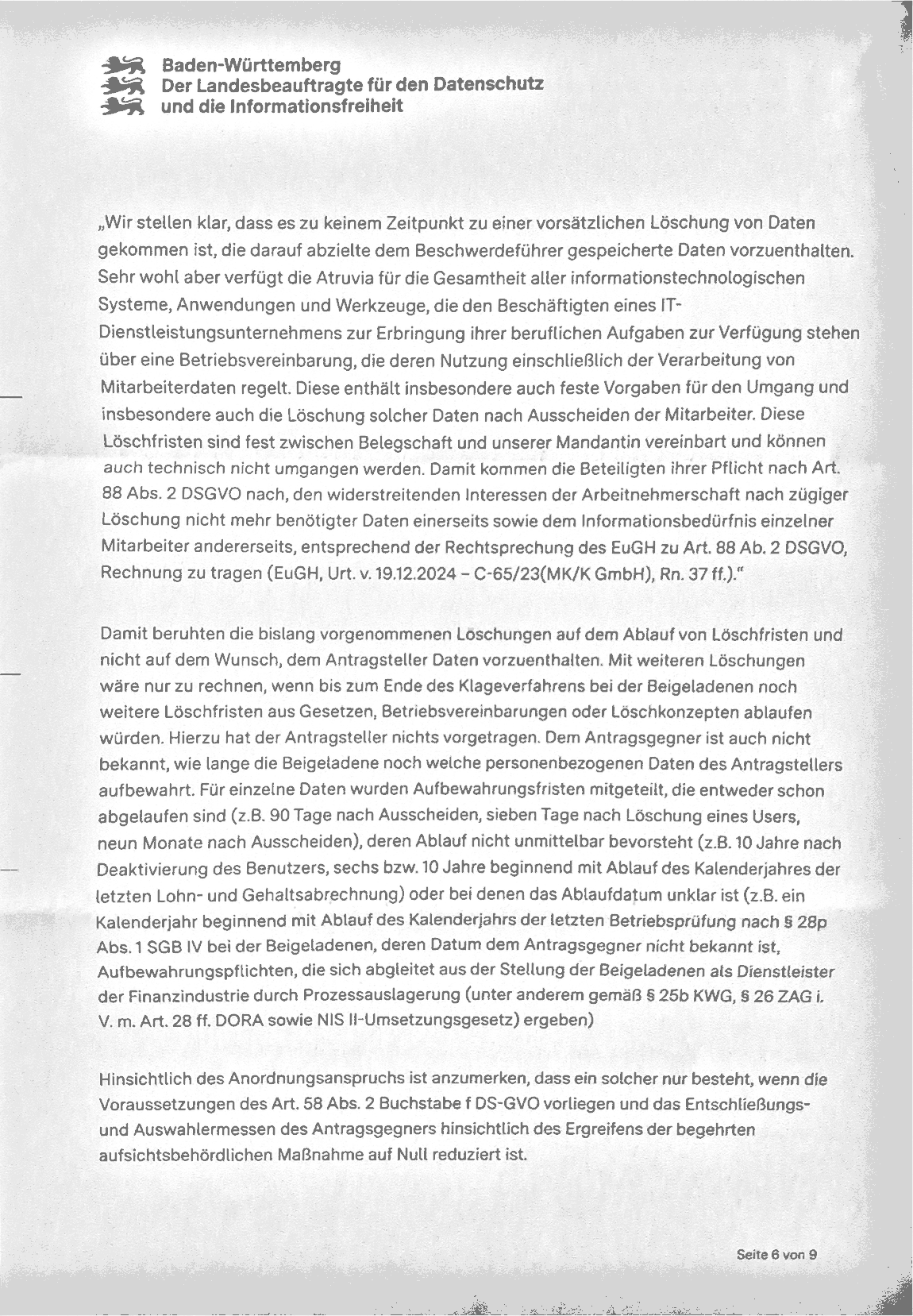
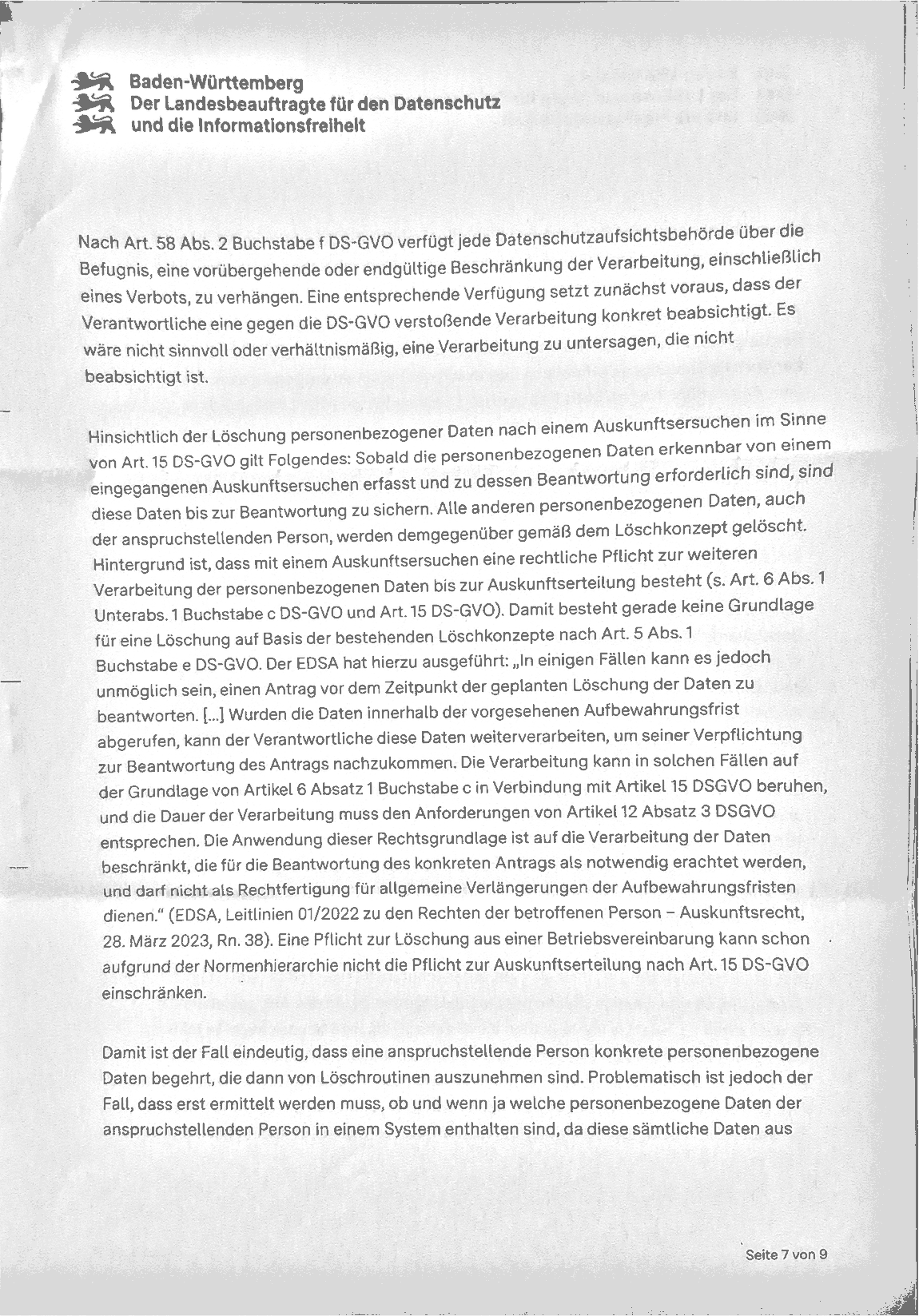
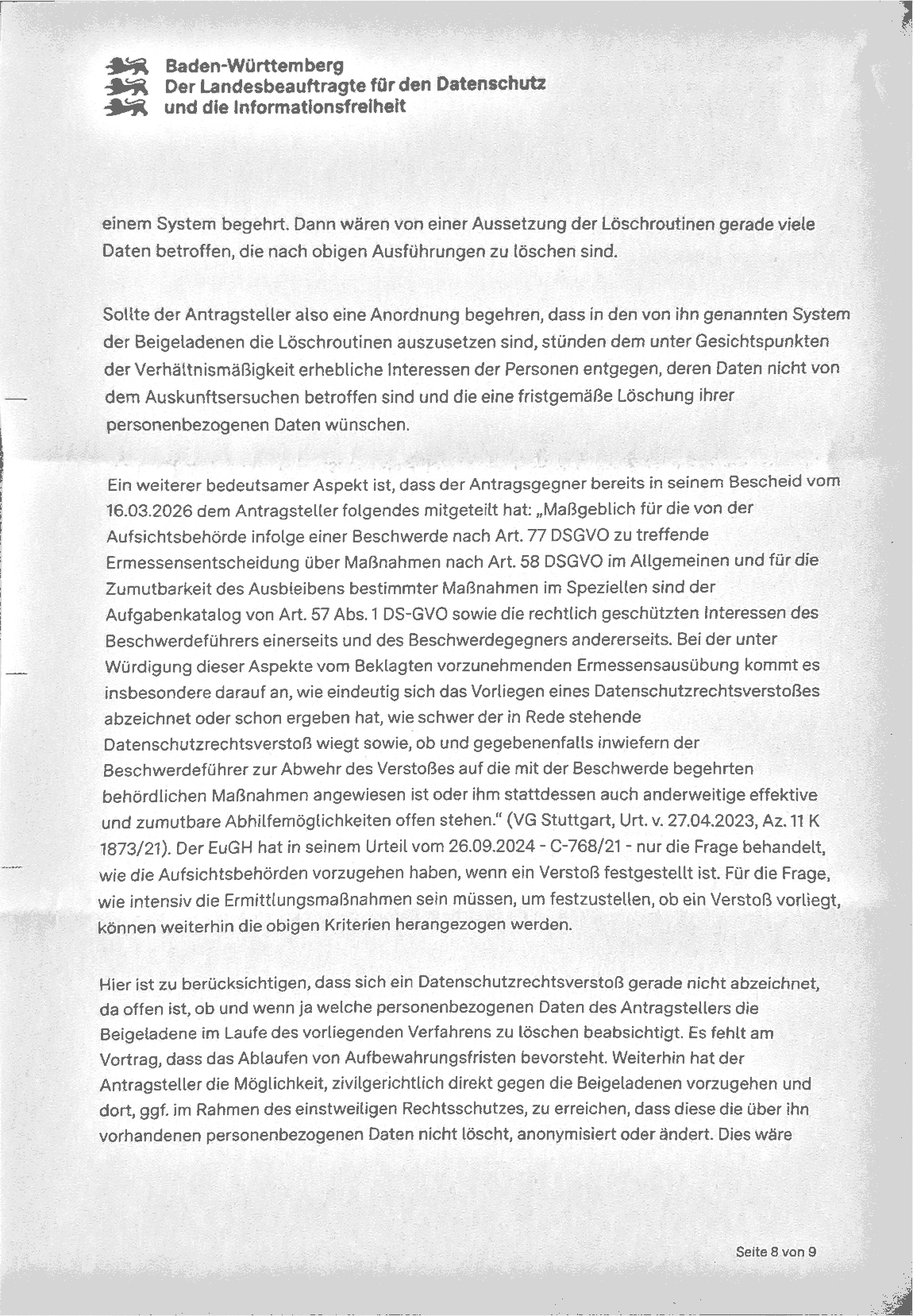
🇬🇧 Read transcript in English by Claude
Working translation — AI-assisted (Claude). Provided for international readers. The German original above is authoritative; this is not a certified translation. Emphasis added. Passages in square brackets are summarised.
Reply to the interim-relief application — 8 July 2026 · LfDI Baden-Württemberg, Dr. Eva Skobel · Ref. LfDIAbt4-0532.3-24/2
Transmitted via the Administrative Court of Stuttgart · Case 14 K 6435/26 (application under § 123 VwGO)
The respondent requests that the application be dismissed with costs.
I. Facts. The applicant is the claimant in case 14 K 4946/26. He originally applied, by pleading of 08.06.2026, for a securing order requiring the joined party (the company) to retain all his personal data unchanged until a final decision and to refrain from any further deletion, alteration or anonymisation. The court then informed him that such an application was probably inadmissible, since an interim order can only bind the respondent authority, not a joined party. He therefore amended his application and now seeks an order obliging the respondent, within its supervisory powers (Art. 58 GDPR), to ensure that the joined party retains all his data unchanged and refrains from deletion, alteration or anonymisation until a final decision.
II. Legal assessment.
1. Admissibility of the amendment. Whether the amendment is expedient is for the court to decide (§ 91 VwGO applied by analogy); the respondent leaves this to the court's discretion. The respondent further notes that the application has not previously been made to it. Since the joined party has had over a year and a half since the first access request in which to delete, alter or anonymise the applicant's personal data, and has not indicated that any such processing is imminent, no exception is apparent which would make a prior application to the authority dispensable on grounds of urgency.
2. Merits. The application is unfounded. The applicant seeks an order under Art. 58(2)(f) GDPR, i.e. the imposition of a temporary ban on certain processing operations (deletion, alteration or anonymisation of his personal data). Under § 123 VwGO an application is well-founded only if both a claim to the order and a ground for the order (urgency) exist, and both must be substantiated.
In the present case there is no ground for the order. There is no reason to assume that the joined party, by deleting, anonymising or altering the applicant's personal data, would pre-empt the course of the proceedings and frustrate a right of access should the court establish one.
The respondent had already informed the joined party by letter of 16 September 2025:
“Personal data that have already been deleted or anonymised cannot and need not be disclosed. However, it would be inadmissible for the controller to delete personal data in view of the access request in order not to have to disclose them. Rather, he is obliged to reflect, as far as possible, the state of the personal data existing at the time the access request was received (see EDPB Guidelines 01/2022 on the rights of the data subject — right of access, 28 March 2023, p. 21 f., para. 37 ff.).”
The joined party stated on this in its statement of 19 December 2025:
“We clarify that at no time has there been an intentional deletion of data aimed at withholding stored data from the complainant. Atruvia does, however, have for the entirety of all information-technology systems, applications and tools available to the employees of an IT service company a works agreement governing their use, including the processing of employee data. This contains, in particular, fixed requirements for the handling and, in particular, the deletion of such data after employees leave. These deletion periods are firmly agreed between the workforce and our client and cannot be circumvented technically either. The parties thereby comply with their obligation under Art. 88(2) GDPR … in accordance with the case law of the CJEU on Art. 88(2) GDPR (CJEU, judgment of 19.12.2024 — C-65/23 (MK/K GmbH), para. 37 ff.).”
Accordingly, the deletions carried out so far were based on the expiry of deletion periods and not on a wish to withhold data from the applicant. Further deletions would only be expected if further deletion periods arising from statutes, works agreements or deletion concepts expire before the end of the court proceedings. The applicant has submitted nothing on this. Nor is the respondent aware how long the joined party still retains which personal data of the applicant. For individual data, retention periods were communicated which have either already expired (e.g. 90 days after leaving, seven days after deletion of a user, nine months after leaving), whose expiry is not imminent (e.g. 10 years after deactivation of the user; six or ten years from the end of the calendar year of the last payroll), or whose expiry date is unclear (including retention obligations derived from the joined party's position as a service provider to the financial industry under § 25b KWG, § 26 ZAG in conjunction with Art. 28 ff. DORA and the NIS-2 implementing act).
As regards the claim to the order, such a claim exists only if the conditions of Art. 58(2)(f) GDPR are met and the respondent's discretion is reduced to zero. An order under Art. 58(2)(f) presupposes that the controller concretely intends a processing operation infringing the GDPR; it would not be sensible or proportionate to prohibit processing which is not intended.
[The pleading then sets out that, once personal data are recognisably covered by a pending access request and necessary to answer it, they must be secured until the request is answered, while all other personal data are deleted in accordance with the deletion concept.]
Affected yourself?
Atruvia is the central IT service provider of all Volksbanken and Raiffeisenbanken. Submit your own GDPR access request — free of charge, without stating reasons.
Create GDPR request →Verified sources
All provisions on which the 24 allegations are based.
The right of access 8
Principles and special data 6
Duties of the supervisory authority 7
Procedure and legal protection 8
Reporting and freedom to conduct a business 4
Cited against the plaintiff — and disputed 4
Summary table · 24.08.2026
Mapping of positions: main demands · document chronology · catalogue of side issues and video evidence (wrong password Atruvia · 05.12.2025) — delivered as an ASiC-E container (Associated Signature Container · ETSI TS 102 918), additionally AES-256 encrypted.
89b665c0eb9d13a5…8dda473ad1fb245a3d3ec603…84fb8ec7Authority rating
Over 21 months. Complaint closed without any substantive assessment; allegations of the joined party adopted without own examination.
Submit your own rating →Related proceedings
All proceedings arise from the same facts. If one fails, it strengthens the others — because the same documents and witness statements are linked.
Conciliation request against Atruvia AG for unauthorised processing of special categories of personal data (Art. 82 GDPR · Art. 28 Swiss Civil Code). Ref. OL 26 729/730 FUI · non-material satisfaction of at least CHF 150,000 + material damage.
pending · URP complaint to the Bern Court of AppealA further proceeding arising from the same facts has been filed. For strategic reasons (service not yet completed), the opponent, reference number and subject matter will be published only after confirmation of receipt.
filed · not publicFurther proceeding arising from the same facts — independent legal basis for the claim. Details will follow after formal receipt by the competent body.
filed · not publicThe legal expenses insurer refuses coverage for the proceedings in the Atruvia complex. Coverage and damages action.
in preparationThe second legal expenses insurer also gives no coverage. Without coverage, the citizen bears the litigation costs provisionally himself — for most of those affected, this is exactly where the proceedings end.
in preparation